
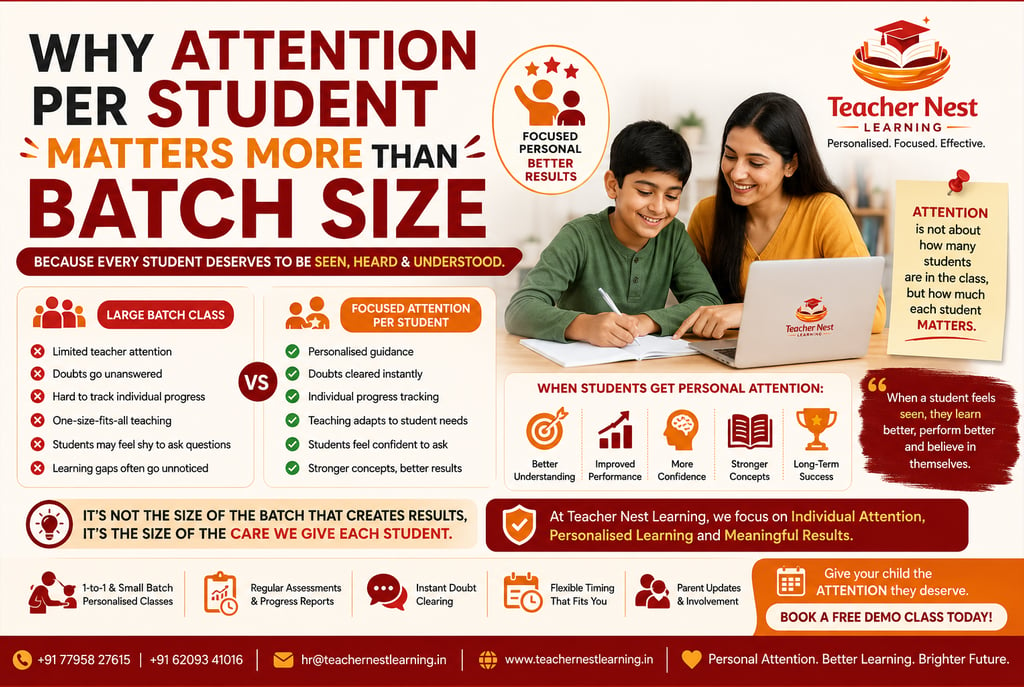
Why Attention Per Student Matters More Than Batch Size
For years, batch size has been treated as an important indicator of teaching quality. Many coaching institutes advertise small batches as a major advantage, while large institutions often highlight the number of students they teach. However, in 2026, education experts increasingly agree on something important: Batch size alone does not determine learning success.
Teacher Nest Consultancy
6/23/20265 min read
Introduction
When parents search for online tuition or coaching classes, one of the first questions they ask is:
"How many students are there in a batch?"
For years, batch size has been treated as an important indicator of teaching quality. Many coaching institutes advertise small batches as a major advantage, while large institutions often highlight the number of students they teach.
However, in 2026, education experts increasingly agree on something important:
Batch size alone does not determine learning success.
What truly impacts a student's performance is the amount of individual attention they receive.
A class with 10 students can still leave some children struggling if the teacher cannot focus on their specific needs. On the other hand, a well-managed class with personalized support can significantly improve understanding, confidence, and academic outcomes.
The real question parents should ask is not:
"How many students are in the class?"
Instead, they should ask:
"How much attention will my child receive?"
The Hidden Problem with Focusing Only on Batch Size
Many parents believe that smaller batches automatically guarantee better learning.
While smaller groups can be beneficial, they do not always ensure effective teaching.
Imagine a classroom with just eight students.
If the teacher follows the same lesson plan for everyone without checking individual understanding, some students may still fall behind.
Now imagine another class where the teacher actively tracks each student's progress, identifies weaknesses, provides personalized feedback, and adjusts lessons accordingly.
Which student is likely to perform better?
The second scenario demonstrates why attention matters more than numbers.
Learning is personal. Every student has different strengths, weaknesses, learning speeds, and goals.
Without individual attention, even a small batch can become ineffective.
Every Student Learns Differently
Research in education consistently shows that students absorb information in different ways.
Some students:
Learn through visual explanations
Understand concepts through examples
Need repeated practice
Prefer interactive discussions
Require additional guidance
A single teaching approach cannot work equally well for every learner.
When teachers provide personalized attention, they can adapt their methods to suit each student.
This flexibility often leads to better understanding and stronger academic performance.
Why Individual Attention Improves Academic Results
Students who receive focused attention tend to:
Ask more questions
Participate actively
Develop stronger fundamentals
Gain confidence
Learn faster
Make fewer mistakes
Educational studies have shown that students receiving personalized instruction often demonstrate significantly higher academic achievement compared to students learning in generalized classroom environments.
The reason is simple.
When teachers notice misunderstandings early, they can correct them before they become bigger learning gaps.
Attention Creates Better Understanding
Many students struggle not because they lack intelligence but because they miss one foundational concept.
For example:
A student who does not fully understand fractions may later struggle with algebra.
A student who misses a grammar concept may find essay writing difficult.
Without individual attention, these small gaps can grow into major academic challenges.
Teachers who monitor each student's progress can quickly identify such issues and provide targeted support.
This prevents confusion from accumulating over time.
Students Feel More Comfortable Asking Questions
One common challenge in large classrooms is hesitation.
Many students:
Feel shy
Fear making mistakes
Worry about judgment
Avoid asking questions
When teachers provide individual attention, students often feel safer expressing doubts.
This creates a positive learning environment where curiosity is encouraged rather than suppressed.
The ability to ask questions freely is one of the strongest predictors of effective learning.
Confidence Grows When Students Are Seen
Every student wants to feel noticed.
When teachers remember a student's strengths, acknowledge progress, and provide encouragement, confidence grows naturally.
Confidence affects:
Classroom participation
Test performance
Problem-solving ability
Academic motivation
Students who believe they can succeed are more likely to persist through difficult topics.
Individual attention helps build that belief.
Learning Speed Is Different for Every Student
One of the biggest limitations of traditional teaching is fixed pacing.
Some students need extra explanation.
Others are ready to move ahead.
When teachers provide personalized attention, they can adjust learning speed according to student needs.
This prevents two common problems:
Students Falling Behind
Students who need more support receive additional guidance.
Students Feeling Bored
Advanced learners receive extra challenges and enrichment opportunities.
Personalized pacing keeps learning effective for everyone.
Better Attention Leads to Better Exam Preparation
Examinations require more than subject knowledge.
Students must also learn:
Time management
Question analysis
Revision strategies
Error correction
Exam techniques
Teachers who know individual students well can provide customized exam guidance.
For example:
One student may need help with speed.
Another may need help with accuracy.
A third may struggle with confidence.
Personalized support helps address these unique challenges.
The Online Learning Advantage
Modern online tutoring platforms have made personalized attention more achievable than ever before.
Technology allows tutors to:
Track progress in real time
Monitor performance trends
Conduct regular assessments
Share personalized resources
Provide instant feedback
The best online learning platforms use technology to enhance teacher-student interaction rather than replace it.
This creates more meaningful learning experiences.
Why Parents Should Look Beyond Student Numbers
When evaluating a tutoring platform, parents often focus on batch size.
A more useful set of questions would be:
How often does the tutor interact with each student?
Will my child receive personalized feedback?
Are learning gaps identified regularly?
Does the teacher monitor progress?
How are doubts resolved?
Can lessons be adapted to my child's needs?
The answers to these questions reveal much more about educational quality than batch size alone.
Signs That a Tutoring Platform Prioritizes Student Attention
Parents should look for tutoring providers that offer:
Personalized Learning Plans
Students receive guidance tailored to their academic goals.
Regular Assessments
Teachers continuously evaluate progress.
Progress Reports
Parents stay informed about learning outcomes.
Interactive Classes
Students actively participate instead of simply listening.
Doubt-Clearing Support
Questions are addressed promptly and effectively.
Flexible Teaching Approaches
Tutors adapt methods according to student needs.
These features indicate a strong focus on individual student success.
How Teacher Nest Learning Focuses on Every Student
At Teacher Nest Learning, the belief is simple:
Every student deserves attention, encouragement, and personalized guidance.
Rather than focusing only on class size, Teacher Nest Learning emphasizes meaningful student engagement.
Students benefit from:
Personalized academic support
Interactive online sessions
Individual progress tracking
Regular feedback
Customized learning strategies
Subject-specific mentoring
Exam-focused preparation
This approach helps students build confidence, strengthen concepts, and achieve their academic goals more effectively.
Whether a student is preparing for school exams, board examinations, JEE, NEET, CUET, or other competitive tests, personalized attention remains at the center of the learning experience.
The Future of Education Is Personal
The education landscape is evolving rapidly.
Artificial intelligence, digital classrooms, and advanced learning tools are transforming how students learn.
Yet one factor remains unchanged:
Students learn best when they feel understood.
Technology can enhance education, but meaningful teacher-student interaction remains essential.
The future belongs to learning environments where students receive individualized guidance, support, and encouragement.
That future is built on attention, not numbers.
Conclusion
Batch size may influence classroom dynamics, but it is not the most important factor in student success.
What truly matters is the quality of interaction between teachers and students.
When students receive personalized attention, they:
Learn more effectively
Ask more questions
Build confidence
Improve academic performance
Develop stronger study habits
Parents searching for the right tutoring platform should focus less on how many students are in a class and more on how well each student is supported.
Because in education, being noticed often matters far more than being counted.
Frequently Asked Questions (FAQs)
Why is student attention more important than batch size?
Student attention allows teachers to identify learning gaps, provide personalized support, and adapt lessons to individual needs, leading to better academic outcomes.
Does a smaller batch automatically mean better learning?
Not always. A small batch can still be ineffective if students do not receive meaningful interaction and personalized guidance from the teacher.
How does personalized attention improve grades?
Teachers can identify weaknesses early, clarify doubts quickly, and provide targeted practice, helping students improve understanding and performance.
What are the benefits of individualized learning?
Individualized learning improves confidence, engagement, concept clarity, retention, and academic achievement.
How can parents evaluate the level of attention their child will receive?
Parents should ask about tutor interaction, feedback systems, progress tracking, assessments, and doubt-clearing processes.
Does online tutoring provide enough personal attention?
Yes. Modern online tutoring platforms can offer excellent personalized support through one-on-one sessions, interactive classes, and progress monitoring tools.
Why do shy students benefit from personalized attention?
Personalized environments make students feel comfortable asking questions and expressing doubts without fear of judgment.
Can personalized attention help with competitive exams?
Absolutely. Teachers can address individual weaknesses, improve exam strategies, and create customized preparation plans.
How does Teacher Nest Learning provide personalized support?
Teacher Nest Learning offers interactive online classes, progress tracking, individualized guidance, regular assessments, and customized learning plans tailored to student needs.
Is personalized attention important for all age groups?
Yes. Students from primary school through higher secondary education benefit from individualized instruction and targeted academic support.
© 2026. All rights reserved Teacher Nest Learning™
Contact & Support


Teacher Nest Learning is a 1-to-1 online tuition platform offering personalized learning for CBSE, ICSE, IB, IGCSE, and State Boards. Our expert tutors focus on concept clarity, academic improvement, and preparation for competitive exams like JEE and NEET.
Email Us : hr@teachernestlearning.in
Class 9-10 (High)
Class 6-8 (Middle)
Class 11-12 (Higher)
Boards & Competitive
Student Resources
• Book a Free Demo
• Course Syllabus
• FAQ
• Study Materials
• Blog
Terms & Conditions
Refund & Cancellation Policy
Career
📍Registered Office: Dhanbad, Jharkhand, India.
+91 7795827615
+91 6209341016