
The Psychology Behind Why Students Hesitate to Ask Doubts in Class
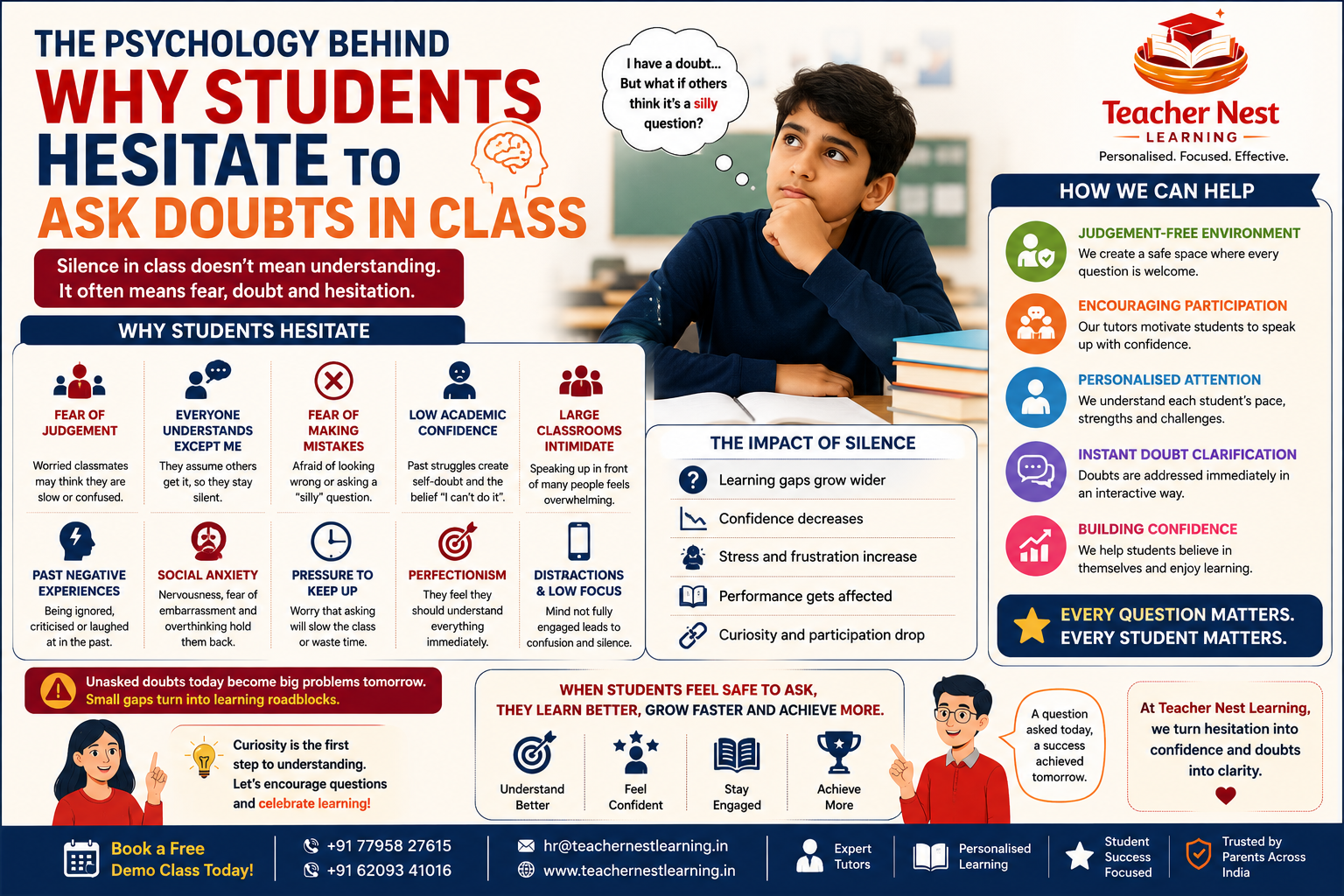
Understanding why students avoid asking doubts can help parents, teachers, and tutoring platforms create environments where learning becomes more comfortable and effective.
Teacher Nest Learning
6/23/20266 min read
Introduction
Every teacher has experienced it.
A lesson ends, and the teacher asks:
"Does anyone have any doubts?"
The classroom falls silent.
Students nod their heads, and no hands go up.
But when the class is over, the same students may approach the teacher individually, message their tutor later, or struggle with the concept during homework.
This situation is surprisingly common. Studies in educational psychology suggest that a significant percentage of students regularly avoid asking questions even when they do not fully understand the topic being taught.
The problem is not usually a lack of curiosity.
In many cases, students genuinely want to learn but hesitate because of psychological barriers.
Understanding why students avoid asking doubts can help parents, teachers, and tutoring platforms create environments where learning becomes more comfortable and effective.
Asking Questions Is a Sign of Learning
Many people mistakenly believe that students who ask questions are weak in academics.
In reality, the opposite is often true.
Questions indicate:
Active thinking
Curiosity
Engagement
Critical reasoning
Desire to understand deeply
Students who regularly ask doubts tend to develop stronger conceptual understanding than students who simply memorize information.
The challenge is that many students do not see questioning in this positive way.
Instead, they associate it with embarrassment or fear.
Fear of Being Judged
One of the strongest psychological reasons students stay silent is fear of judgment.
Students often wonder:
"Will my classmates think I'm slow?"
"Is this a silly question?"
"Everyone else seems to understand."
"What if I get laughed at?"
This fear becomes particularly strong during middle school and teenage years.
At this stage, students become highly aware of peer opinions.
The desire to fit in can sometimes become more powerful than the desire to learn.
As a result, students choose silence even when they need help.
The "Everyone Understands Except Me" Illusion
Psychologists call this phenomenon the illusion of transparency.
Students assume that everyone else understands the lesson perfectly.
In reality, many classmates may be equally confused.
However, because nobody is asking questions, each student believes they are the only one struggling.
This creates a cycle:
Students stay quiet.
Others interpret the silence as understanding.
More students hesitate to ask.
Confusion grows.
One student's question could actually help many others, but the psychological barrier prevents it from happening.
Fear of Making Mistakes
Many education systems place strong emphasis on correct answers.
Over time, students begin to associate mistakes with failure.
When this happens, asking questions feels risky.
Students may think:
"I should already know this."
"I don't want to appear unprepared."
"What if my question sounds wrong?"
This fear is particularly common among high-achieving students.
Ironically, students who perform well academically often place enormous pressure on themselves to appear knowledgeable at all times.
This can discourage them from asking important questions.
Low Academic Confidence
Confidence plays a major role in classroom participation.
Students who have struggled academically in the past may develop negative beliefs about their abilities.
They may start thinking:
"I'm not good at this subject."
"Others are smarter than me."
"I probably won't understand anyway."
These thoughts reduce the likelihood of asking questions.
The issue becomes psychological rather than academic.
Even when help is available, students may hesitate to seek it.
Large Classrooms Can Feel Intimidating
The size of a classroom affects student behavior.
In larger groups, students often feel more self-conscious.
When dozens of classmates are present, asking a question can feel like standing on a stage.
Students may worry about:
Speaking publicly
Being evaluated
Receiving negative reactions
Drawing attention to themselves
This is one reason why personalized learning environments often encourage greater participation.
Smaller, supportive settings make students feel safer expressing doubts.
Previous Negative Experiences Matter
A student's past experiences can shape future behavior.
Consider a student who once:
Received criticism for asking a question
Was laughed at by classmates
Was told to "pay attention"
Felt ignored by a teacher
Even a single negative incident can make students reluctant to ask questions again.
The brain remembers uncomfortable experiences and tries to avoid repeating them.
As a result, students may remain silent even when they need help.
Social Anxiety and Classroom Participation
Some students experience social anxiety, which can make speaking in front of others extremely difficult.
Symptoms may include:
Nervousness
Increased heart rate
Sweaty palms
Fear of embarrassment
Difficulty speaking
These students often understand the importance of asking questions but struggle with the emotional challenge of doing so.
Supportive learning environments can help reduce this anxiety over time.
The Pressure to Keep Up
Modern classrooms often move quickly through lessons.
Students sometimes worry that asking questions will:
Slow down the class
Annoy the teacher
Waste other students' time
Instead of seeking clarification, they choose to remain silent and hope they understand later.
Unfortunately, this approach often leads to larger learning gaps.
Small doubts can become major obstacles when left unresolved.
Perfectionism Can Prevent Questions
Many students believe they should understand everything immediately.
This mindset creates unrealistic expectations.
When students encounter confusion, they may interpret it as a personal failure.
Perfectionistic thoughts include:
"I should know this already."
"Smart students don't ask basic questions."
"I need to figure it out myself."
In reality, learning involves confusion, mistakes, and continuous questioning.
The most successful learners are often the most curious learners.
Digital Distractions and Reduced Engagement
Today's students face constant distractions from phones, social media, games, and digital content.
Sometimes students hesitate to ask questions because they are only partially engaged during lessons.
When attention decreases:
Understanding decreases.
Confidence decreases.
Participation decreases.
Interactive teaching methods help students remain focused and involved.
Why Unasked Doubts Become Bigger Problems
A small misunderstanding may seem harmless.
However, learning is cumulative.
Each new concept builds on previous knowledge.
For example:
Weak fractions knowledge affects algebra.
Weak grammar affects writing.
Weak scientific fundamentals affect advanced topics.
When doubts remain unresolved, academic challenges multiply over time.
This is why immediate clarification is so important.
How Teachers Can Encourage Questions
Teachers play a critical role in creating psychologically safe classrooms.
Effective strategies include:
Normalizing Questions
Teachers can remind students that confusion is a natural part of learning.
Praising Curiosity
Recognizing thoughtful questions encourages participation.
Creating a Judgment-Free Environment
Students should never feel embarrassed for seeking clarification.
Using Anonymous Question Systems
Some students feel more comfortable asking questions privately.
Encouraging Small Discussions
Peer discussions often help students gain confidence before speaking publicly.
How Parents Can Help at Home
Parents can also reduce hesitation by changing how they discuss learning.
Instead of asking:
"Did you get everything right?"
Try asking:
"What did you learn today?"
or
"What confused you today?"
These questions reinforce the idea that confusion is a normal part of education.
Parents who celebrate effort, curiosity, and persistence help children develop stronger learning confidence.
The Role of Personalized Learning
One of the biggest advantages of personalized tutoring is that students often feel more comfortable asking questions.
In one-on-one or highly interactive sessions:
Students receive individual attention.
Teachers notice confusion quickly.
Questions are encouraged.
Learning becomes collaborative.
Many students who remain silent in large classrooms become highly engaged when given personalized support.
How Teacher Nest Learning Helps Students Overcome Doubt Anxiety
At Teacher Nest Learning, creating a supportive learning environment is a core priority.
Students are encouraged to:
Ask questions freely
Explore concepts deeply
Learn at their own pace
Build confidence gradually
Through interactive online classes, personalized guidance, and regular feedback, students develop the confidence to express doubts without fear of judgment.
Rather than focusing only on completing the syllabus, Teacher Nest Learning emphasizes understanding, participation, and long-term academic growth.
This approach helps students become independent learners who are comfortable asking questions and seeking knowledge.
Why Questions Are the Foundation of Success
History's greatest discoveries began with questions.
Scientists, inventors, mathematicians, and leaders all started by asking:
"Why?"
"How?"
"What if?"
The same principle applies in education.
Students who ask questions gain deeper understanding, stronger problem-solving skills, and greater confidence.
The goal of learning is not to know everything.
The goal is to keep learning.
And learning begins with curiosity.
Conclusion
Students hesitate to ask doubts for many psychological reasons, including fear of judgment, low confidence, social anxiety, perfectionism, and classroom pressure.
Understanding these factors helps educators and parents create environments where students feel safe to participate.
When students are encouraged to ask questions without fear, they become more engaged, confident, and successful learners.
Every doubt asked is an opportunity for growth.
Every question answered is a step toward deeper understanding.
The most successful students are not those who never have doubts.
They are the ones who are willing to ask about them.
Frequently Asked Questions (FAQs)
Why do students hesitate to ask doubts in class?
Students often fear judgment, embarrassment, criticism, or appearing less knowledgeable than their peers.
Is asking questions a sign of weakness?
No. Asking questions is a sign of curiosity, engagement, and active learning.
How does fear affect classroom participation?
Fear can reduce confidence, increase anxiety, and prevent students from seeking help when needed.
Why do shy students avoid asking questions?
Shy students may worry about public speaking, social judgment, or drawing attention to themselves.
Can unasked doubts affect academic performance?
Yes. Small misunderstandings can grow into larger learning gaps that impact future understanding and exam performance.
How can teachers encourage students to ask more questions?
Teachers can create supportive environments, praise curiosity, normalize mistakes, and encourage open discussions.
How can parents help children become more confident learners?
Parents can encourage curiosity, avoid criticizing mistakes, and create opportunities for open conversations about learning challenges.
Does personalized tutoring help students ask more doubts?
Yes. Personalized learning environments often reduce anxiety and encourage students to seek clarification more freely.
Why is confidence important in learning?
Confident students are more likely to participate, ask questions, take academic risks, and persist through challenges.
How does Teacher Nest Learning support students who hesitate to ask questions?
Teacher Nest Learning provides personalized guidance, interactive classes, and a supportive environment where students can comfortably ask questions, clarify concepts, and build confidence.
© 2026. All rights reserved Teacher Nest Learning™
Contact & Support


Teacher Nest Learning is a 1-to-1 online tuition platform offering personalized learning for CBSE, ICSE, IB, IGCSE, and State Boards. Our expert tutors focus on concept clarity, academic improvement, and preparation for competitive exams like JEE and NEET.
Email Us : hr@teachernestlearning.in
Class 9-10 (High)
Class 6-8 (Middle)
Class 11-12 (Higher)
Boards & Competitive
Student Resources
• Book a Free Demo
• Course Syllabus
• FAQ
• Study Materials
• Blog
Terms & Conditions
Refund & Cancellation Policy
Career
📍Registered Office: Dhanbad, Jharkhand, India.
+91 7795827615
+91 6209341016