
Signs Your Child Is Struggling Academically But Not Telling You
This guide will help parents identify these hidden signs and know how to support their child before the problem grows
TEACHER NEST LEARNING
6/27/20264 min read
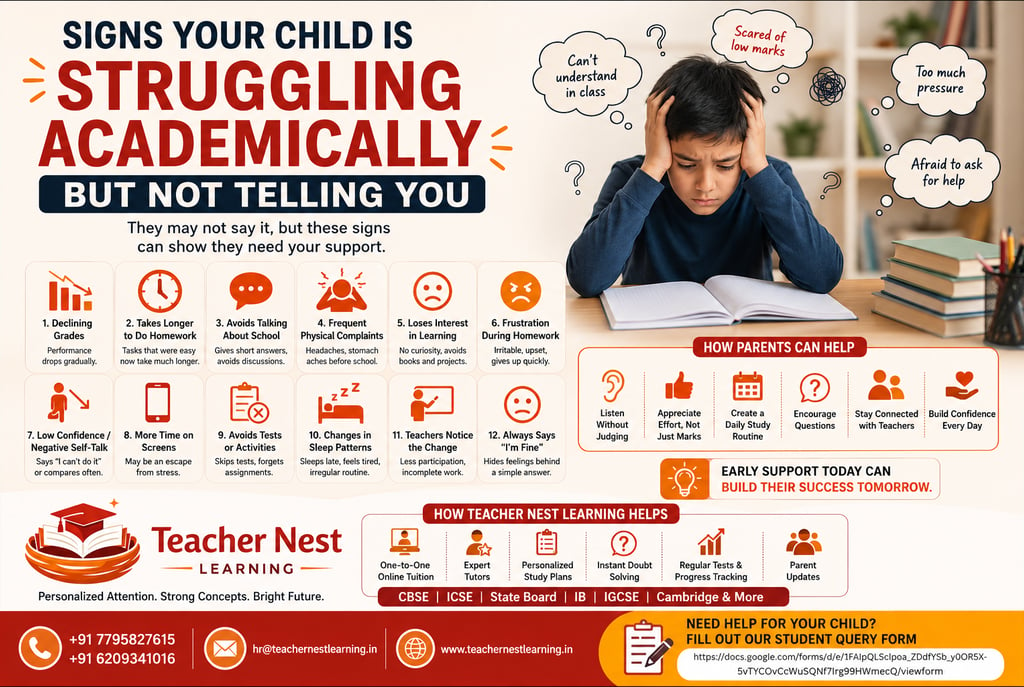
Children don't always say, "I'm finding studies difficult." In fact, many students hide their academic struggles because they fear disappointing their parents, being compared with others, or feeling embarrassed.
According to educational psychology studies, nearly 1 in 3 school students experiences academic stress, yet many never openly discuss it with their parents. This is why recognizing the early warning signs is extremely important.
At Teacher Nest Learning, we've worked with students from CBSE, ICSE, State Boards, IB, IGCSE, and Cambridge curricula, and we've noticed that academic struggles often begin quietly before they become serious.
This guide will help parents identify these hidden signs and know how to support their child before the problem grows.
Why Children Hide Their Academic Problems
Children may avoid talking about school difficulties for several reasons:
Fear of being scolded
Fear of disappointing parents
Comparison with classmates or siblings
Low self-confidence
Anxiety about exams
Feeling that nobody will understand
Instead of asking for help, many children simply become quieter or change their behavior.
1. Grades Are Slowly Declining
One poor test score isn't always a concern.
However, if your child consistently scores lower than before, it may indicate:
Conceptual gaps
Difficulty understanding classroom teaching
Lack of confidence
Reduced interest in studies
A gradual decline is often more concerning than one bad exam.
2. Homework Takes Much Longer Than Before
Does homework that once took 45 minutes now require two or three hours?
Possible reasons include:
Difficulty understanding concepts
Poor concentration
Constant distractions
Fear of making mistakes
Children often pretend they're "studying" while actually struggling with the material.
3. They Avoid Talking About School
Notice if your child starts giving very short answers like:
"School was fine."
"Nothing happened."
"Everything's okay."
Children who are struggling often avoid discussions about:
Exams
Homework
Teachers
Report cards
This avoidance is sometimes an emotional defense mechanism.
4. Frequent Complaints Before School
If your child regularly complains about:
Headaches
Stomach aches
Feeling tired
Feeling unwell
especially before school or tuition, it may not always be a medical issue.
Academic anxiety can sometimes appear as physical symptoms.
5. Loss of Interest in Learning
Children who once enjoyed learning may suddenly:
Stop asking questions
Avoid reading books
Lose curiosity
Refuse to participate in projects
This often happens when repeated academic difficulties reduce confidence.
6. Increased Frustration During Homework
Watch for signs like:
Throwing books
Crying easily
Getting angry over simple questions
Giving up quickly
These reactions usually indicate frustration rather than laziness.
7. Comparing Themselves Constantly
Statements such as:
"Everyone is smarter than me."
"I'll never score well."
"I'm the weakest student."
can indicate declining academic confidence.
Negative self-talk should never be ignored.
8. Spending More Time on Screens
While phones and games aren't always the cause of poor academics, excessive screen time can sometimes become an escape from school-related stress.
Children may choose entertainment because studying feels overwhelming.
9. Avoiding Tests or School Activities
Some students begin:
Skipping tests
Forgetting assignments
Missing project submissions
Avoiding competitions
This isn't always due to carelessness.
Often, they're trying to avoid situations where they fear failure.
10. Sleep Patterns Change
Academic stress can affect sleep.
Signs include:
Sleeping very late
Difficulty falling asleep
Waking frequently
Feeling tired every morning
Good sleep is closely linked to academic performance and memory.
11. Teachers Mention Lack of Participation
Teachers may notice:
Less classroom interaction
Reduced confidence
Poor attention
Incomplete assignments
Regular communication with teachers can help identify problems early.
12. They Say "I'm Fine" Too Often
Children sometimes hide their emotions behind simple answers.
If you repeatedly notice signs of struggle but your child insists everything is okay, gentle conversations are more effective than repeated questioning.
Common Reasons Students Struggle Academically
Some of the most common causes include:
Weak foundation in previous classes
Large classroom sizes
Fear of asking doubts
Lack of personal attention
Exam anxiety
Poor study habits
Time management issues
Learning gaps after school changes
Excessive extracurricular commitments
The good news is that most of these challenges can be addressed with the right guidance.
How Parents Can Help
Instead of focusing only on marks, try these approaches:
Listen Without Judging
Allow your child to explain difficulties without interrupting.
Appreciate Effort
Praise consistency, improvement, and hard work rather than only high scores.
Build a Daily Study Routine
Even one focused hour each day is better than several distracted hours.
Encourage Questions
Make your child feel comfortable asking doubts without fear.
Stay Connected With Teachers
Regular communication helps identify problems early.
Avoid Constant Comparisons
Every child learns at a different pace.
How Teacher Nest Learning Helps Students Regain Confidence
At Teacher Nest Learning, we understand that every child learns differently.
Instead of one-size-fits-all teaching, we provide personalized academic support designed to strengthen both understanding and confidence.
Our students benefit from:
One-to-one online tuition
Experienced subject experts
Personalized learning plans
Regular doubt-solving sessions
Homework assistance
Weekly progress tracking
Parent feedback sessions
Flexible class schedules
CBSE, ICSE, State Board, IB, IGCSE, and Cambridge curriculum support
Our focus isn't just improving marks. We help students become confident, independent learners who enjoy studying again.
Statistics Every Parent Should Know
Recent educational research suggests:
Around 30% of students experience academic-related stress during their school years.
Students receiving personalized academic support often demonstrate higher engagement and improved confidence.
Studies consistently show that early intervention leads to significantly better learning outcomes than waiting until final exams.
These numbers highlight why recognizing early warning signs can make a lasting difference.
Frequently Asked Questions (FAQs)
How can I tell if my child is struggling in school without saying anything?
Look for changes in behavior, declining grades, increased frustration, avoidance of homework, reduced confidence, and reluctance to discuss school.
Should I be worried if my child's marks suddenly fall?
A single poor result isn't necessarily a concern, but a consistent decline may indicate learning gaps or emotional stress that should be addressed early.
Can online tuition help struggling students?
Yes. Personalized online tuition provides focused attention, immediate doubt resolution, and customized learning strategies that help students rebuild confidence and improve academically.
How does Teacher Nest Learning support struggling students?
Teacher Nest Learning offers one-to-one online classes, expert tutors, personalized study plans, regular assessments, homework support, and continuous progress updates for parents. Our goal is to strengthen concepts while helping students feel more confident and motivated.
Is academic struggle always caused by lack of effort?
No. Many students struggle because of weak fundamentals, exam anxiety, learning gaps, classroom pace, or lack of individual attention rather than a lack of effort.
Final Thoughts
Children often don't announce when they're struggling. Instead, they communicate through changes in behavior, confidence, and daily habits.
Recognizing these early signs allows parents to offer support before academic challenges become overwhelming.
With patience, encouragement, and the right guidance, every child can regain confidence and improve their performance. If your child needs personalized support, Teacher Nest Learning is committed to helping them overcome academic difficulties and develop a lifelong love for learning.
© 2026. All rights reserved Teacher Nest Learning™
Contact & Support


Teacher Nest Learning is a 1-to-1 online tuition platform offering personalized learning for CBSE, ICSE, IB, IGCSE, and State Boards. Our expert tutors focus on concept clarity, academic improvement, and preparation for competitive exams like JEE and NEET.
Email Us : hr@teachernestlearning.in
Class 9-10 (High)
Class 6-8 (Middle)
Class 11-12 (Higher)
Boards & Competitive
Student Resources
• Book a Free Demo
• Course Syllabus
• FAQ
• Study Materials
• Blog
Terms & Conditions
Refund & Cancellation Policy
Career
📍Registered Office: Dhanbad, Jharkhand, India.
+91 7795827615
+91 6209341016