IGCSE for Indian Students: Is It Worth Switching From CBSE?
In this detailed guide, we explain what IGCSE is, how it compares with CBSE, its advantages and disadvantages, and whether switching boards is the right decision for Indian students.
TAECHER NEST LEARNING
6/24/20265 min read
As education becomes increasingly global, many Indian parents are exploring international curricula that can provide broader academic opportunities and better preparation for global universities. One of the most popular options is the IGCSE curriculum.
However, a common question arises among families:
"Should we switch from CBSE to IGCSE?"
The answer depends on a student's learning style, career goals, academic strengths, and future plans. While IGCSE offers flexibility and international recognition, CBSE continues to be one of India's most successful and competitive education systems.
In this detailed guide, we explain what IGCSE is, how it compares with CBSE, its advantages and disadvantages, and whether switching boards is the right decision for Indian students.
What is IGCSE?
The International General Certificate of Secondary Education (IGCSE) is an internationally recognized qualification developed by the University of Cambridge.
It is typically offered to students aged 14 to 16 years and serves as the foundation for advanced international programs such as:
A Levels
International Baccalaureate (IB)
Foundation Programs
Global University Admissions
Today, IGCSE is taught in over 150 countries and is accepted by universities worldwide.
The curriculum focuses on critical thinking, research skills, practical applications, and conceptual understanding rather than memorization.
What is CBSE?
The Central Board of Secondary Education (CBSE) is India's largest national education board.
CBSE follows a structured curriculum designed to align closely with competitive examinations such as:
JEE Main
JEE Advanced
NEET
CUET
NDA
More than 25,000 schools in India and abroad follow the CBSE curriculum.
The board emphasizes conceptual learning while maintaining a standardized national framework.
Why Are Parents Considering IGCSE?
The education landscape is changing rapidly.
Many parents want their children to develop skills such as:
Critical thinking
Communication
Creativity
Problem solving
Research ability
Independent learning
These skills are strongly emphasized within the IGCSE curriculum.
Families planning international university admissions also view IGCSE as a pathway that aligns well with global education standards.
IGCSE vs CBSE: Key Differences
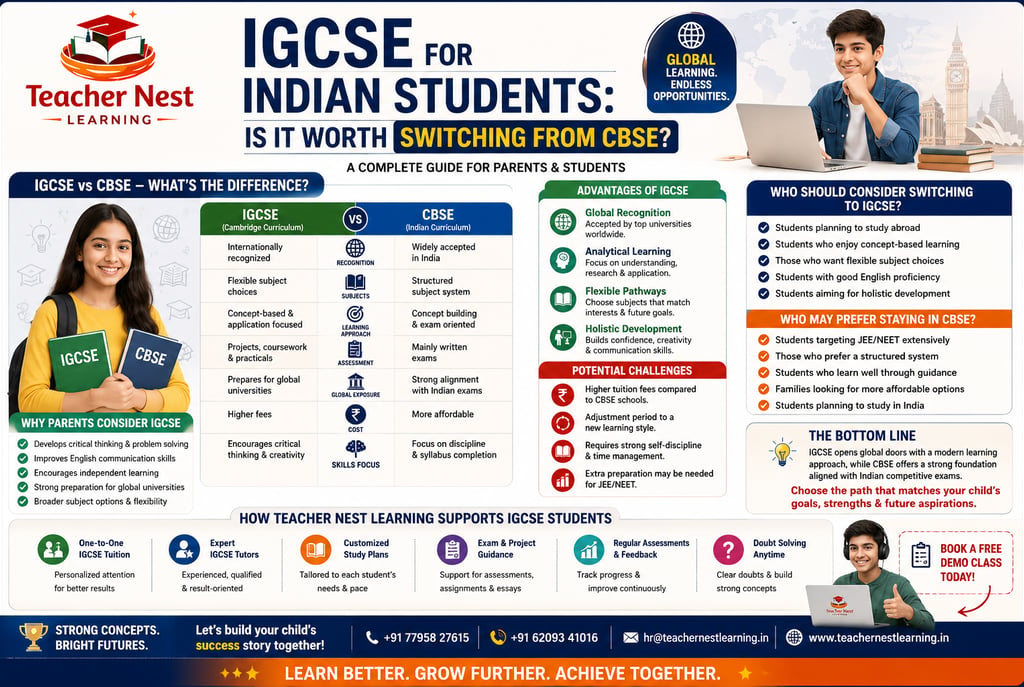
Curriculum Structure
CBSE follows a standardized syllabus across India.
IGCSE offers greater flexibility and allows students to choose from a wider variety of subjects.
Students can often select combinations that match their interests and future goals.
Learning Approach
CBSE focuses on concept building and exam preparation.
IGCSE focuses on:
Application-based learning
Analytical thinking
Research projects
Practical assessments
Real-world problem solving
Assessment Style
CBSE examinations primarily rely on written tests.
IGCSE incorporates:
Coursework
Practical assessments
Projects
Written examinations
This provides multiple ways for students to demonstrate learning.
Subject Choices
IGCSE schools typically offer:
Business Studies
Global Perspectives
Environmental Management
Media Studies
Travel and Tourism
Design and Technology
Students can customize their academic pathway much earlier.
International Recognition
Both boards are recognized globally.
However, IGCSE is specifically designed as an international curriculum and may be more familiar to universities in countries such as:
United Kingdom
United States
Canada
Australia
Singapore
Is IGCSE More Difficult Than CBSE?
This is one of the most frequently asked questions.
The answer is nuanced.
Why Some Students Find IGCSE Easier
Less emphasis on memorization
More practical learning
Flexible subject combinations
Application-focused questions
Why Some Students Find IGCSE Harder
Requires independent thinking
Strong research skills needed
Continuous assessments
Extensive project work
Higher expectations in analytical writing
The challenge level depends largely on a student's learning style.
Students who enjoy understanding concepts and applying knowledge often perform very well in IGCSE.
Advantages of Switching from CBSE to IGCSE
Global Curriculum
IGCSE prepares students for international academic environments.
Improved Critical Thinking
Students learn to analyze, evaluate, and interpret information independently.
Flexible Subject Selection
Students can explore interests beyond traditional academic streams.
Better University Readiness
Many universities value the research and analytical skills developed through IGCSE.
Strong Communication Skills
The curriculum promotes effective writing, presentation, and discussion skills.
Holistic Development
Students develop academic and practical competencies simultaneously.
Potential Challenges of Switching to IGCSE
Higher School Fees
IGCSE schools are generally more expensive than CBSE schools.
Adjustment Period
Students may need time to adapt to new teaching and assessment methods.
Different Examination Pattern
The transition from rote-based learning to analytical learning can initially be challenging.
Competitive Exam Alignment
Students preparing specifically for JEE or NEET may require additional coaching because the curriculum differs from CBSE.
Who Should Consider Switching to IGCSE?
IGCSE may be an excellent choice for students who:
Plan to study abroad
Enjoy research-based learning
Prefer conceptual understanding
Want flexible subject options
Have strong English communication skills
Thrive in project-based environments
These students often benefit significantly from the international perspective offered by IGCSE.
Who May Prefer Staying in CBSE?
CBSE may remain the better choice for students who:
Are targeting JEE or NEET extensively
Prefer structured learning
Learn well through guided instruction
Need affordable schooling options
Intend to remain within India's higher education system
Many top-performing engineers, doctors, civil servants, and entrepreneurs have emerged from CBSE schools.
Best Time to Switch from CBSE to IGCSE
Education experts generally recommend switching before major board years.
The ideal transition periods are:
Class 6
Class 7
Class 8
Class 9
Earlier transitions allow students to adapt comfortably to the IGCSE teaching methodology.
Switching during Class 10 or Class 12 can be more challenging due to examination requirements.
How Teacher Nest Learning Supports IGCSE Students
The IGCSE curriculum demands strong conceptual understanding, analytical skills, and personalized academic support.
At Teacher Nest Learning, students receive:
One-to-one online tuition
Experienced IGCSE subject experts
Customized learning plans
Cambridge-aligned teaching methods
Regular assessments
Homework support
Exam preparation guidance
Doubt-clearing sessions
Whether students are transitioning from CBSE to IGCSE or already studying under the Cambridge curriculum, Teacher Nest Learning provides individualized support that helps them adapt confidently and perform at their best.
Our tutors focus on helping students understand concepts deeply rather than simply preparing for exams.
Career Opportunities After IGCSE
Completing IGCSE opens pathways to numerous academic and professional opportunities.
Students can continue with:
Cambridge A Levels
International Baccalaureate (IB)
ISC
CBSE Senior Secondary
Foundation Programs
Future careers may include:
Engineering
Medicine
Business Management
Finance
Data Science
Law
Design
Architecture
International Relations
Research
Entrepreneurship
The curriculum's emphasis on critical thinking and communication is highly valued across industries.
Is IGCSE Worth It for Indian Students?
For many students, yes.
IGCSE provides:
International exposure
Flexible learning
Advanced thinking skills
Strong communication abilities
University readiness
However, the decision should depend on the student's goals rather than educational trends.
If international education, broader subject choices, and analytical learning are priorities, IGCSE can be an excellent investment.
If the primary goal is Indian competitive examinations, CBSE may offer a more direct route.
There is no universally superior board. The best board is the one that aligns with a student's aspirations, learning preferences, and long-term plans.
Conclusion
The choice between CBSE and IGCSE is not about which board is better. It is about which board is better for a particular student.
IGCSE offers a globally recognized curriculum focused on critical thinking, creativity, and application-based learning. CBSE provides a strong academic foundation that aligns closely with India's competitive examination ecosystem.
Before making the switch, families should carefully evaluate the student's academic goals, preferred learning style, budget, and future education plans.
With proper academic guidance and personalized support from Teacher Nest Learning, students can successfully navigate either curriculum and achieve outstanding results.
Frequently Asked Questions (FAQs)
What does IGCSE stand for?
IGCSE stands for International General Certificate of Secondary Education.
Is IGCSE accepted in India?
Yes. IGCSE qualifications are recognized by Indian universities and educational institutions.
Is IGCSE harder than CBSE?
Not necessarily. IGCSE focuses more on analytical and application-based learning, while CBSE is more structured and exam-oriented.
Is IGCSE good for studying abroad?
Yes. IGCSE is widely accepted by universities and colleges worldwide.
Can students switch from CBSE to IGCSE?
Yes. Many students transition successfully, especially during middle school years.
Does IGCSE help with university admissions?
Yes. Many global universities value the critical thinking and research skills developed through the IGCSE curriculum.
Can IGCSE students appear for JEE and NEET?
Yes. However, students may need additional preparation to align with Indian competitive exam syllabi.
Is IGCSE expensive compared to CBSE?
Generally, IGCSE schools have higher tuition fees due to international curriculum requirements.
How does Teacher Nest Learning help IGCSE students?
Teacher Nest Learning provides expert one-to-one IGCSE tuition, personalized study plans, exam preparation, and continuous academic support tailored to Cambridge curriculum requirements.
Is switching from CBSE to IGCSE worth it?
For students seeking international education, flexible learning, and strong analytical skill development, switching to IGCSE can be highly beneficial. The decision should always be based on individual goals and learning preferences.
© 2026. All rights reserved Teacher Nest Learning™
Contact & Support
Teacher Nest Learning is a 1-to-1 online tuition platform offering personalized learning for CBSE, ICSE, IB, IGCSE, and State Boards. Our expert tutors focus on concept clarity, academic improvement, and preparation for competitive exams like JEE and NEET.
Email Us : hr@teachernestlearning.in
Class 9-10 (High)
Class 6-8 (Middle)
Class 11-12 (Higher)
Boards & Competitive
Student Resources
• Book a Free Demo
• Course Syllabus
• FAQ
• Study Materials
• Blog
Terms & Conditions
Refund & Cancellation Policy
Career
📍Registered Office: Dhanbad, Jharkhand, India.
+91 7795827615
+91 6209341016