ICSE Board Explained: Syllabus, Difficulty and Career Paths
This guide explains everything about the ICSE board, including its syllabus, difficulty level, advantages, disadvantages, and future career paths.
TEACHER NEST LEARNING
6/24/20265 min read
Choosing the right school board is one of the most important decisions for a student's academic journey. In India, the Indian Certificate of Secondary Education (ICSE) board is widely recognized for its comprehensive curriculum, strong emphasis on English language skills, and balanced approach to academics and practical learning.
Many parents and students often wonder:
Is ICSE harder than CBSE?
What subjects are taught in ICSE?
Is ICSE good for competitive exams?
What career opportunities are available after studying in ICSE?
This guide explains everything about the ICSE board, including its syllabus, difficulty level, advantages, disadvantages, and future career paths.
What is the ICSE Board?
The ICSE (Indian Certificate of Secondary Education) is conducted by the Council for the Indian School Certificate Examinations (CISCE). It is one of India's most respected private education boards and is known for offering a detailed and application-based curriculum.
The ICSE examination is conducted for Class 10 students, while ISC (Indian School Certificate) is conducted for Class 12 students.
Today, thousands of schools across India and abroad are affiliated with CISCE, making ICSE a globally recognized qualification.
Why is ICSE Popular?
The ICSE board has gained popularity because it focuses on:
Strong English communication skills
Detailed subject understanding
Practical learning
Analytical thinking
Project-based assessments
Balanced development of science, mathematics, languages, arts, and humanities
According to various educational surveys, students from ICSE schools often perform exceptionally well in language-based entrance exams, higher education programs, and international admissions due to their strong communication and writing abilities.
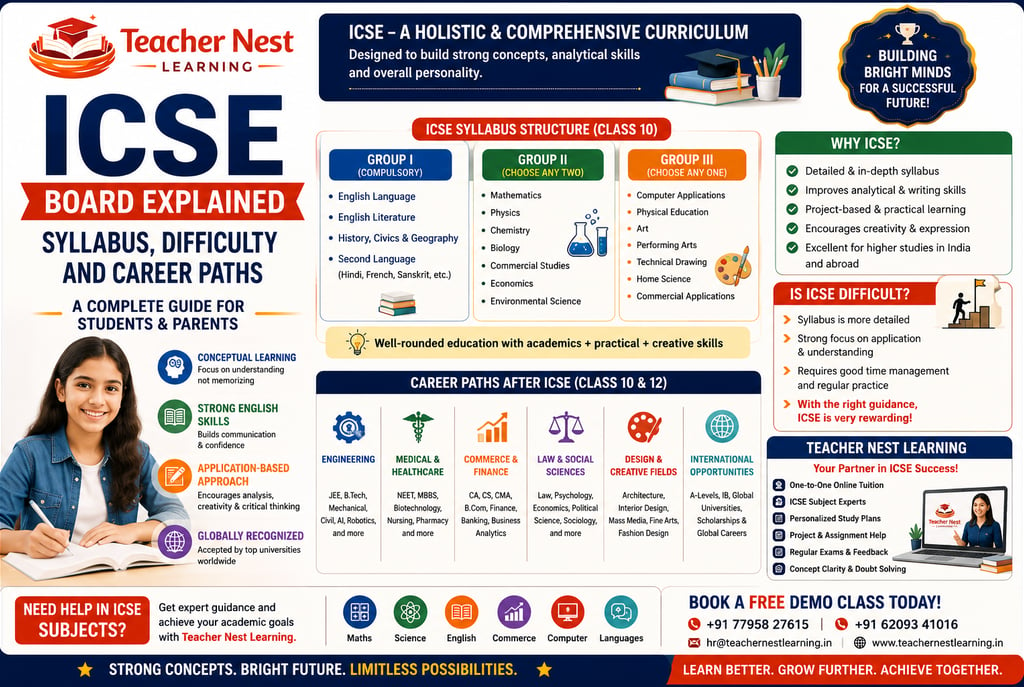
ICSE Syllabus Structure
One of the biggest differences between ICSE and other boards is the depth of its syllabus.
The curriculum is designed to provide conceptual clarity rather than rote memorization.
Group I Subjects (Compulsory)
Students generally study:
English Language
English Literature
History, Civics and Geography
Second Language (Hindi, French, Sanskrit, etc.)
Group II Subjects
Students select subjects such as:
Mathematics
Physics
Chemistry
Biology
Commercial Studies
Economics
Environmental Science
Group III Subjects
Students choose practical and skill-based subjects including:
Computer Applications
Physical Education
Art
Performing Arts
Technical Drawing
Home Science
Commercial Applications
This broad curriculum helps students develop both academic knowledge and practical skills.
Is the ICSE Board Difficult?
This is one of the most common questions asked by students and parents.
The answer is that ICSE is not necessarily difficult, but it is more detailed than many other boards.
Students are expected to:
Understand concepts deeply
Write descriptive answers
Complete projects and assignments
Develop analytical thinking
Improve communication skills
Because of this, students often spend more time studying and practicing writing-based questions.
Why Students Find ICSE Challenging
Extensive Syllabus
The ICSE curriculum covers topics in greater detail.
Strong English Requirement
Students must develop advanced vocabulary, grammar, and writing skills.
Project Work
Internal assessments and projects contribute significantly to learning.
Application-Based Questions
Questions often test understanding rather than memorization.
However, with proper guidance and consistent study habits, students can perform extremely well.
ICSE vs CBSE: Which is Better?
Many families compare ICSE and CBSE while choosing schools.
ICSE
Detailed curriculum
Strong English focus
Project-based learning
Application-oriented questions
Broad subject exposure
CBSE
More concise syllabus
Strong alignment with JEE and NEET
Easier transfer between schools
Widely accepted across India
Neither board is universally better.
The right choice depends on the student's learning style, future goals, and interests.
Students who enjoy in-depth learning often thrive in ICSE, while those targeting highly competitive entrance exams may prefer CBSE's streamlined approach.
Benefits of Studying in ICSE
Excellent English Skills
ICSE students often develop strong writing, reading, and communication abilities.
These skills help in:
College admissions
Interviews
Public speaking
International education
Balanced Education
Students study a mix of sciences, languages, humanities, and creative subjects.
Strong Foundation
The curriculum builds deep conceptual understanding.
Better Analytical Skills
Students learn to evaluate, analyze, and interpret information.
International Recognition
Many universities worldwide recognize ICSE and ISC qualifications.
Challenges of the ICSE Board
Like every education system, ICSE has certain challenges.
Larger Syllabus
Students must manage a greater volume of content.
Time Management
Project work requires careful planning.
Higher Writing Requirements
Students need strong answer-writing skills.
Increased Academic Load
Some students may initially find the detailed curriculum demanding.
The good news is that personalized academic support can make the learning process much easier.
How Teacher Nest Learning Helps ICSE Students
At Teacher Nest Learning, we understand the unique academic requirements of ICSE students.
Our experienced tutors provide:
One-to-one online tuition
Customized lesson plans
Concept-based learning
Project guidance
Exam preparation strategies
Doubt-clearing sessions
Regular assessments
Whether a student needs help in Mathematics, Physics, Chemistry, Biology, English, or Computer Applications, Teacher Nest Learning ensures personalized support and measurable academic improvement.
Our goal is not just higher marks but deeper understanding and long-term academic success.
Best Study Strategies for ICSE Students
Students can excel in ICSE by following a structured study plan.
Focus on Concepts
Understanding concepts is more important than memorizing answers.
Practice Writing
Regular answer-writing practice improves exam performance.
Revise Weekly
Weekly revision helps retain information longer.
Complete Projects Early
Avoid last-minute project submissions.
Solve Previous Year Papers
Past papers help students understand question patterns and marking schemes.
Seek Expert Guidance
Professional mentoring can significantly improve confidence and performance.
Career Paths After ICSE
One of the biggest myths is that ICSE limits career options.
In reality, ICSE students can pursue virtually every major career pathway.
Engineering
Students can prepare for:
JEE Main
JEE Advanced
State Engineering Entrance Exams
Medical
Students can prepare for:
NEET
AIIMS-related programs
Allied Health Sciences
Commerce and Finance
Students can pursue:
Chartered Accountancy (CA)
Company Secretary (CS)
Finance and Banking
Humanities and Social Sciences
Students often excel in:
Psychology
Economics
Political Science
Sociology
Law
Design and Creative Careers
ICSE's balanced curriculum supports careers in:
Graphic Design
Architecture
Animation
Fine Arts
Fashion Design
International Education
Strong English proficiency makes ICSE students competitive for global university admissions.
Is ICSE Good for Competitive Exams?
Yes.
While the syllabus is broader, the strong conceptual foundation helps students prepare for:
JEE
NEET
CUET
SAT
CLAT
NDA
Olympiads
Many successful candidates in national and international examinations have come from ICSE schools.
Future Scope of ICSE Education
The future of education increasingly values:
Critical thinking
Communication skills
Problem-solving abilities
Creativity
Adaptability
These are exactly the skills that the ICSE curriculum aims to develop.
As industries continue to evolve, students with strong analytical and communication skills are likely to remain highly competitive.
Conclusion
The ICSE board is known for its rigorous yet rewarding curriculum. It encourages students to think critically, communicate effectively, and build a strong academic foundation.
Although the syllabus may appear challenging initially, the benefits often extend far beyond school examinations. Students gain skills that help them succeed in higher education, competitive exams, and future careers.
With proper guidance, consistent effort, and personalized academic support from Teacher Nest Learning, ICSE students can confidently achieve excellent results and unlock a wide range of career opportunities.
Frequently Asked Questions (FAQs)
What does ICSE stand for?
ICSE stands for Indian Certificate of Secondary Education, conducted by CISCE.
Is ICSE harder than CBSE?
ICSE is generally considered more detailed and application-oriented, while CBSE has a more concise syllabus.
Is ICSE good for competitive exams?
Yes. ICSE provides strong conceptual clarity, which is beneficial for JEE, NEET, CUET, SAT, and other entrance exams.
Does ICSE improve English skills?
Yes. ICSE places significant emphasis on English language and literature, helping students develop excellent communication skills.
Can ICSE students pursue engineering and medicine?
Absolutely. ICSE students regularly succeed in engineering, medical, commerce, law, and humanities entrance examinations.
Is ICSE recognized internationally?
Yes. ICSE and ISC qualifications are recognized by universities and educational institutions worldwide.
How can Teacher Nest Learning help ICSE students?
Teacher Nest Learning provides personalized online tuition, expert tutors, regular assessments, project guidance, and exam preparation support tailored specifically for ICSE students.
Which subjects are most important in ICSE?
All subjects contribute to overall development, but Mathematics, Science, English, and Computer Applications are often key focus areas.
Are project marks important in ICSE?
Yes. Internal assessments and project work play an important role in overall academic performance.
What is the best way to score high marks in ICSE?
Students should focus on conceptual understanding, regular revision, answer-writing practice, previous-year papers, and expert guidance from experienced educators such as Teacher Nest Learning.
© 2026. All rights reserved Teacher Nest Learning™
Contact & Support
Teacher Nest Learning is a 1-to-1 online tuition platform offering personalized learning for CBSE, ICSE, IB, IGCSE, and State Boards. Our expert tutors focus on concept clarity, academic improvement, and preparation for competitive exams like JEE and NEET.
Email Us : hr@teachernestlearning.in
Class 9-10 (High)
Class 6-8 (Middle)
Class 11-12 (Higher)
Boards & Competitive
Student Resources
• Book a Free Demo
• Course Syllabus
• FAQ
• Study Materials
• Blog
Terms & Conditions
Refund & Cancellation Policy
Career
📍Registered Office: Dhanbad, Jharkhand, India.
+91 7795827615
+91 6209341016