IB vs CBSE: Choosing the Right Board for Your Child's Future
Blog post description.
Teacher Nest Learning
6/24/20265 min read
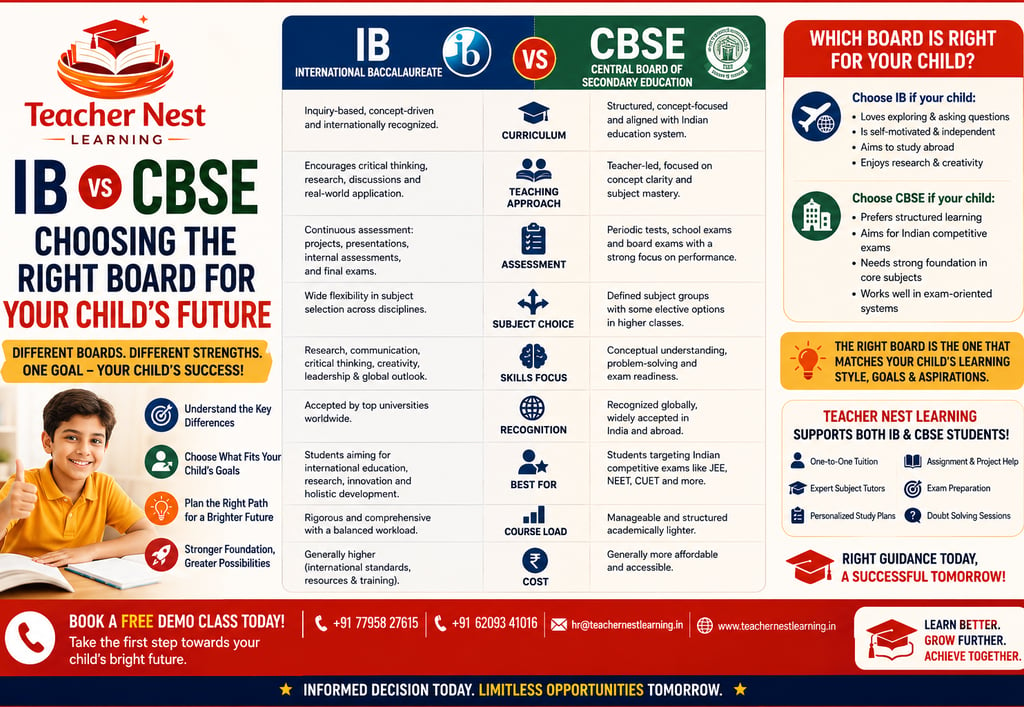
Selecting the right educational board is one of the most important decisions parents make for their child's academic journey. In India, two of the most popular options are the International Baccalaureate (IB) and the Central Board of Secondary Education (CBSE). Both offer quality education, but they differ significantly in teaching methods, assessment styles, curriculum structure, and future opportunities.
Many parents wonder: Should my child study in CBSE or IB? Which board prepares students better for college admissions? Is IB worth the higher cost? Will CBSE limit international opportunities?
The answer depends on your child's learning style, career aspirations, and long-term educational goals.
This comprehensive guide will help parents understand the differences between IB and CBSE and make an informed decision for their child's future.
Understanding the IB Curriculum
The International Baccalaureate (IB) is a globally recognized educational framework followed in more than 150 countries. It is designed to develop critical thinking, research skills, creativity, communication abilities, and international-mindedness.
Instead of focusing mainly on memorization, the IB curriculum encourages students to ask questions, solve real-world problems, conduct independent research, and develop analytical skills.
The IB system is divided into:
Primary Years Programme (PYP)
Middle Years Programme (MYP)
Diploma Programme (DP)
Career-related Programme (CP)
The most popular stage among Indian students is the IB Diploma Programme (Grades 11 and 12), which is highly valued by international universities.
Students learn through projects, presentations, research papers, discussions, and practical applications rather than solely relying on examinations.
Understanding the CBSE Curriculum
The Central Board of Secondary Education (CBSE) is India's most widely adopted national educational board. It follows a structured syllabus designed according to national educational objectives and competitive examination requirements.
CBSE emphasizes conceptual understanding, academic discipline, and subject mastery. The curriculum is standardized across India, making it easier for students who relocate frequently.
The board is particularly advantageous for students preparing for:
JEE
NEET
CUET
NDA
UPSC foundation studies
Other Indian competitive examinations
Most Indian schools follow CBSE because it provides a balanced and affordable education while maintaining academic rigor.
Major Differences Between IB and CBSE
Teaching Methodology
IB focuses on inquiry-based learning.
Students are encouraged to investigate topics independently, conduct research, participate in discussions, and develop critical thinking abilities.
CBSE follows a more structured teaching approach.
Teachers guide students through a defined syllabus, ensuring strong conceptual foundations and systematic learning.
Assessment Style
IB assessment includes:
Research projects
Internal assessments
Essays
Presentations
Practical work
Final examinations
A student's overall performance is evaluated throughout the academic year.
CBSE relies more heavily on:
Periodic tests
School examinations
Board examinations
Academic performance is largely measured through written assessments.
Curriculum Flexibility
IB offers greater flexibility in subject selection.
Students can combine subjects from different disciplines and customize their learning pathways.
CBSE follows a more fixed curriculum structure, although elective choices are available in higher grades.
Focus on Skills
IB places strong emphasis on:
Communication skills
Research abilities
Creativity
Problem-solving
Leadership
Global awareness
CBSE focuses on:
Subject knowledge
Conceptual understanding
Academic performance
Competitive exam readiness
International Recognition
IB enjoys extensive recognition among universities worldwide.
Many leading institutions in:
United States
Canada
United Kingdom
Australia
Europe
Singapore
actively appreciate IB students because of their research and analytical skills.
CBSE is also recognized internationally but is primarily designed for the Indian educational ecosystem.
IB vs CBSE: Academic Difficulty
A common misconception is that one board is easier than the other.
The reality is that both are challenging in different ways.
IB demands:
Continuous assessments
Extensive writing
Research projects
Time management
Independent learning
CBSE demands:
Strong conceptual understanding
Examination performance
Consistent academic preparation
Mastery of large syllabi
Students who enjoy research and independent thinking often thrive in IB.
Students who perform well in structured environments and standardized examinations often excel in CBSE.
Which Board Is Better for Engineering Aspirants?
For students targeting engineering entrance exams such as JEE Main and JEE Advanced, CBSE often provides a natural advantage.
According to data from India's engineering entrance ecosystem, a significant percentage of successful JEE candidates come from CBSE schools because the examination syllabus closely aligns with CBSE concepts.
Benefits of CBSE for engineering aspirants include:
Alignment with JEE syllabus
Strong focus on Physics, Chemistry, and Mathematics
Familiar examination patterns
Easier integration with coaching programs
However, IB students can also succeed in engineering admissions with proper guidance and supplementary preparation.
Which Board Is Better for Medical Aspirants?
Students preparing for NEET generally find CBSE more aligned with the examination framework.
The National Medical Commission and NEET syllabus largely reflect NCERT-based concepts, which are extensively covered within the CBSE curriculum.
Advantages of CBSE for medical students include:
Strong Biology curriculum
NCERT alignment
Competitive exam preparation support
Structured subject progression
Which Board Is Better for Studying Abroad?
IB has a significant advantage when it comes to international university admissions.
Universities often appreciate IB students because they demonstrate:
Independent research capability
Academic writing skills
Critical thinking
Time management
Interdisciplinary understanding
Many admissions officers recognize the rigor of the IB Diploma Programme.
For students planning undergraduate education abroad, IB can provide a smoother transition into university-level learning.
Cost Comparison: IB vs CBSE
One practical consideration for families is cost.
IB schools generally charge significantly higher fees due to:
International accreditation
Specialized faculty training
Smaller class sizes
Advanced resources
Research-oriented learning environment
CBSE schools are generally more affordable and accessible.
For many families, CBSE offers excellent value while maintaining high educational standards.
Student Personality and Learning Style
The best board often depends on the child rather than the curriculum.
IB may be suitable if your child:
Enjoys discussions
Loves research
Is self-motivated
Thinks creatively
Wants international exposure
CBSE may be suitable if your child:
Prefers structured learning
Performs well in examinations
Plans to appear for Indian competitive exams
Benefits from teacher-guided instruction
Understanding your child's strengths can make the decision much easier.
Future Career Impact
Both boards can lead to successful careers.
Students from both IB and CBSE have gained admission to prestigious institutions such as:
IITs
AIIMS
Oxford
Cambridge
Harvard
Stanford
National Law Universities
Success ultimately depends on:
Student effort
Quality teaching
Consistent practice
Proper guidance
The board provides the framework, but the student's dedication determines the outcome.
How Teacher Nest Learning Supports Both IB and CBSE Students
At Teacher Nest Learning, we understand that every curriculum has unique requirements.
Our experienced tutors provide personalized one-to-one online tuition for both IB and CBSE students, helping them achieve academic excellence through structured guidance and individualized learning plans.
Our support includes:
IB HL and SL subject tutoring
CBSE subject coaching
Mathematics support
Science tutoring
Language learning assistance
Exam preparation strategies
Doubt-clearing sessions
Assignment and project guidance
Whether your child studies in IB or CBSE, Teacher Nest Learning ensures focused attention, customized lesson plans, and measurable academic improvement.
Final Verdict
There is no universal winner in the IB vs CBSE debate.
Choose IB if your child values inquiry-based learning, international exposure, research skills, and plans to study abroad.
Choose CBSE if your child aims for Indian competitive examinations, prefers structured academics, and seeks a cost-effective education pathway.
The best board is the one that aligns with your child's goals, learning style, and future aspirations.
With the right support system, students from both boards can achieve remarkable academic success and build bright futures.
Frequently Asked Questions (FAQs)
Is IB harder than CBSE?
IB is generally considered more demanding in terms of research, projects, and continuous assessments, while CBSE is more examination-focused.
Which board is better for IIT preparation?
CBSE is usually more aligned with JEE preparation because of its syllabus structure and NCERT foundation.
Which board is better for studying abroad?
IB is widely recognized by international universities and often provides an advantage during global admissions.
Can a CBSE student get admission abroad?
Yes. Thousands of CBSE students successfully gain admission to international universities every year.
Is IB accepted in India?
Yes. Indian universities fully recognize IB qualifications.
Which board develops better critical thinking skills?
IB places a stronger emphasis on critical thinking, research, and inquiry-based learning.
Is CBSE easier than IB?
Not necessarily. Both boards are rigorous but challenge students in different ways.
Which board is more affordable?
CBSE schools are generally more affordable than IB schools.
How can Teacher Nest Learning help IB students?
Teacher Nest Learning provides expert IB tutors, personalized one-to-one sessions, assignment guidance, internal assessment support, and exam preparation.
How can Teacher Nest Learning help CBSE students?
Teacher Nest Learning offers subject-specific tutoring, concept clarification, board exam preparation, and competitive exam support for CBSE students.
Is IB good for engineering and medical careers?
Yes, but students may require additional preparation for Indian entrance examinations like JEE and NEET.
What is the biggest advantage of CBSE?
Its strong alignment with Indian competitive examinations and standardized curriculum.
Which board is best for holistic development?
IB is often praised for fostering communication, leadership, creativity, and global awareness.
Can students switch from CBSE to IB?
Yes, although adjustment may be required because teaching and assessment styles differ significantly.
How do I decide between IB and CBSE?
Consider your child's learning preferences, future education plans, career goals, personality, and budget before making a decision.
© 2026. All rights reserved Teacher Nest Learning™
Contact & Support
Teacher Nest Learning is a 1-to-1 online tuition platform offering personalized learning for CBSE, ICSE, IB, IGCSE, and State Boards. Our expert tutors focus on concept clarity, academic improvement, and preparation for competitive exams like JEE and NEET.
Email Us : hr@teachernestlearning.in
Class 9-10 (High)
Class 6-8 (Middle)
Class 11-12 (Higher)
Boards & Competitive
Student Resources
• Book a Free Demo
• Course Syllabus
• FAQ
• Study Materials
• Blog
Terms & Conditions
Refund & Cancellation Policy
Career
📍Registered Office: Dhanbad, Jharkhand, India.
+91 7795827615
+91 6209341016