
How to Talk to Your Child About Low Marks Without Damaging Confidence
Blog post description.
TEACHER NEST LEARNING
6/27/20265 min read
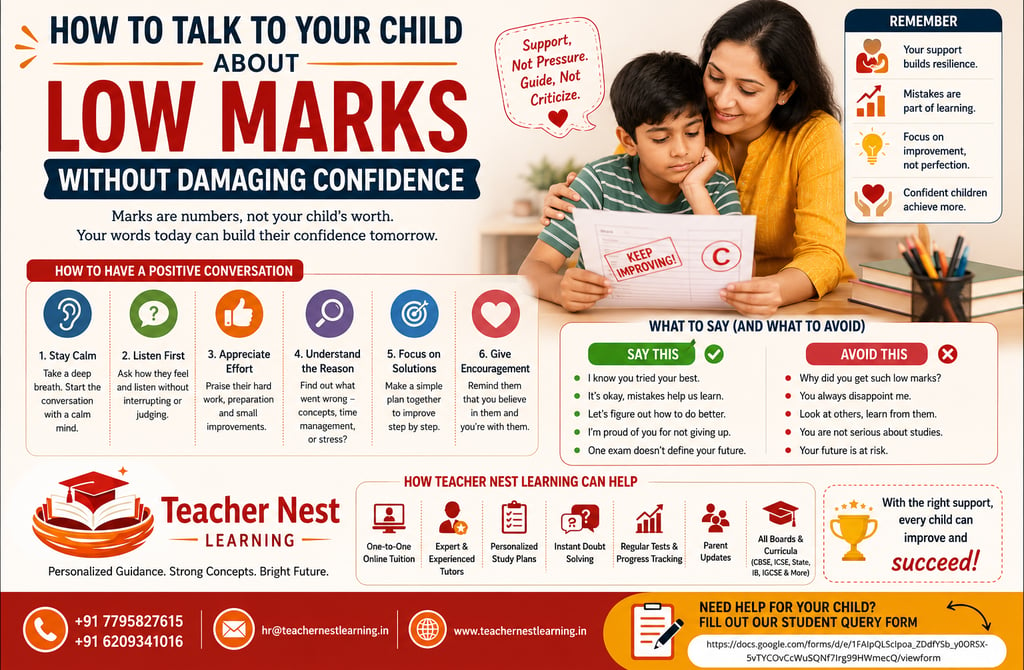
Every parent wants their child to perform well in school. But when report cards arrive with lower-than-expected marks, emotions often take over. Disappointment, worry, frustration, and fear about the future can lead to conversations that unintentionally hurt a child's confidence.
The truth is that low marks are not the end of a student's academic journey. They are simply feedback that something needs attention. What matters most is how parents respond in those crucial moments.
Research in educational psychology shows that children who receive supportive guidance after academic setbacks develop greater resilience, better problem-solving skills, and stronger long-term performance than children who are criticized or compared with others.
At Teacher Nest Learning, we've worked with hundreds of students who improved significantly after receiving the right academic support and emotional encouragement. This guide will help parents turn disappointing marks into valuable learning opportunities.
Why Children Feel Bad About Low Marks
Children don't just see marks as numbers.
Many associate marks with:
Their intelligence
Their parents' approval
Their future success
Their self-worth
Their friendships
When parents react harshly, children often think:
"I'm not smart."
"I've disappointed everyone."
"I'll never improve."
"No matter how hard I try, I'll fail."
These thoughts reduce motivation far more than the actual marks themselves.
Stay Calm Before Starting the Conversation
Parents are naturally emotional.
But reacting immediately with anger usually creates fear instead of improvement.
Instead:
Take a few minutes to calm yourself.
Read the report carefully.
Look at all subjects instead of focusing only on the lowest marks.
Think about what your child might be feeling.
Remember:
Your first conversation after the results is often the one your child remembers for years.
Start With Curiosity, Not Criticism
Instead of asking:
❌ "Why did you get such low marks?"
Try:
✔ "How do you feel about your results?"
✔ "Which subjects felt difficult?"
✔ "Was there anything that made studying harder?"
Open-ended questions encourage honest communication.
Children become more willing to discuss problems when they don't feel judged.
Avoid Comparing Your Child
Perhaps the biggest mistake parents make is saying:
"Look at your cousin."
"Your friend scored 95%."
"Everyone else did better."
Comparison creates:
jealousy
resentment
anxiety
low confidence
Every child learns differently.
Progress should always be compared with the child's previous performance, not someone else's.
Separate Marks From Identity
Never label your child.
Avoid statements like:
❌ "You're lazy."
❌ "You're careless."
❌ "You'll never succeed."
Instead say:
✔ "These marks aren't what you wanted."
✔ "Let's figure out what happened."
✔ "You can improve with the right strategy."
Children should believe:
"I got low marks."
Not:
"I am a failure."
That difference changes everything.
Listen More Than You Speak
Many children already know they performed poorly.
What they need isn't another lecture.
Sometimes the real reasons include:
Difficulty understanding concepts
Fear of asking doubts
Health issues
Exam anxiety
Poor time management
Lack of concentration
Bullying
Overloaded schedules
Listening helps identify the actual problem.
Praise Effort, Not Just Results
Imagine two students.
Student A scores 95% with little effort.
Student B improves from 45% to 65% after months of hard work.
Who deserves more appreciation?
Both do.
Celebrate:
consistency
discipline
practice
improvement
determination
This develops a growth mindset, which psychologists associate with better long-term academic success.
Focus on Solutions
Instead of discussing mistakes repeatedly, shift toward improvement.
Questions to ask:
Which chapter was hardest?
Which subject needs more attention?
What study habit should change?
Should we create a better timetable?
Would extra guidance help?
Solutions build confidence.
Blame destroys it.
Help Your Child Create a Simple Improvement Plan
Avoid overwhelming them.
Instead create a realistic plan.
Example:
Monday
45 minutes Mathematics
20 minutes revision
Tuesday
Science concepts
English reading
Wednesday
Practice questions
Doubt solving
Small daily improvements produce big results over time.
Watch for Signs of Academic Stress
Low marks sometimes affect mental health.
Parents should notice signs such as:
loss of confidence
avoiding school
crying frequently
poor sleep
loss of appetite
excessive screen time
giving up easily
saying "I'm useless"
These signs require emotional support, not criticism.
Teach That Mistakes Are Normal
Many successful people struggled in school before finding success.
Children should understand:
mistakes teach
practice improves performance
intelligence develops over time
Failure is an event.
It is never an identity.
Don't Punish Every Low Score
Taking away everything your child enjoys may reduce motivation.
Instead of banning:
sports
hobbies
music
drawing
Use them as healthy stress relievers.
Balanced students often perform better academically.
Build Better Study Habits Together
Ask questions like:
Is the study environment quiet?
Is the timetable realistic?
Does your child revise regularly?
Are doubts being cleared quickly?
Is enough sleep being taken?
Good habits often matter more than longer study hours.
When Should Parents Consider Extra Academic Support?
Sometimes students genuinely need additional guidance.
Signs include:
repeatedly low marks
weak fundamentals
fear of certain subjects
inability to solve application-based questions
lack of confidence
unfinished syllabus
poor exam-writing skills
Professional tutoring can identify learning gaps that schools may not have enough time to address individually.
How Teacher Nest Learning Helps Students Recover From Low Marks
At Teacher Nest Learning, we believe every child can improve with the right support.
Our experienced tutors focus on understanding each student's learning style rather than simply completing the syllabus.
We provide:
One-to-one online tuition
Personalized study plans
Doubt-solving sessions
Regular assessments
Progress tracking
CBSE, ICSE, IB, IGCSE, and State Board support
JEE and NEET foundation coaching
Concept-based teaching
Confidence-building through consistent mentoring
Our goal isn't just higher marks. It's helping students enjoy learning again and believe in their abilities.
What Educational Research Says
Several educational studies highlight the importance of positive parental involvement:
Students with supportive parents are significantly more likely to perform well academically.
Positive reinforcement improves motivation and classroom engagement.
Children with a growth mindset recover faster from setbacks.
Regular feedback and emotional support reduce exam-related anxiety.
These findings reinforce that encouragement often leads to better long-term results than punishment.
Simple Phrases That Build Confidence
Instead of saying:
❌ "You failed."
Say:
✔ "We'll improve together."
Instead of:
❌ "You're not serious."
Say:
✔ "Let's make a better study routine."
Instead of:
❌ "I'm disappointed."
Say:
✔ "I know you can do better, and I'll help you."
Small changes in language make a lasting difference.
Final Thoughts
Marks are important, but they do not define a child's future.
Children remember how their parents made them feel far longer than they remember individual exam scores.
A calm conversation, patient listening, and practical support can transform disappointment into determination.
Every setback is an opportunity to learn, improve, and grow stronger.
At Teacher Nest Learning, we believe confidence is the foundation of academic success. With personalized guidance, experienced tutors, and continuous encouragement, students can overcome academic challenges and unlock their true potential.
Frequently Asked Questions (FAQs)
1. Should I scold my child for getting low marks?
No. Scolding often increases stress and reduces confidence. Calm discussions and problem-solving are much more effective.
2. How can I motivate my child after poor exam results?
Encourage effort, identify learning gaps, set small achievable goals, and celebrate improvements instead of focusing only on marks.
3. Is private tuition necessary after low marks?
Not always. However, if your child repeatedly struggles, personalized tutoring like Teacher Nest Learning can help strengthen concepts and improve confidence.
4. How do I know if my child has exam anxiety?
Signs include excessive worry, poor sleep, stomach aches before exams, fear of tests, and avoiding discussions about school.
5. Can confidence affect academic performance?
Yes. Confident students participate more, ask questions, handle mistakes better, and generally perform better over time.
6. How does Teacher Nest Learning help weak students?
Teacher Nest Learning provides personalized one-to-one online tuition, regular assessments, doubt-solving sessions, progress tracking, and customized study plans to help students improve both academically and emotionally.
7. What should I say immediately after seeing low marks?
Start with empathy. Ask your child how they feel, listen carefully, and reassure them that one exam does not define their future. Then work together on an improvement plan.
Conclusion
Low marks are a chapter, not the whole story. When parents replace criticism with compassion and guidance, children gain the confidence to improve. Combined with the right academic support from Teacher Nest Learning, even disappointing results can become the starting point for remarkable success.
© 2026. All rights reserved Teacher Nest Learning™
Contact & Support


Teacher Nest Learning is a 1-to-1 online tuition platform offering personalized learning for CBSE, ICSE, IB, IGCSE, and State Boards. Our expert tutors focus on concept clarity, academic improvement, and preparation for competitive exams like JEE and NEET.
Email Us : hr@teachernestlearning.in
Class 9-10 (High)
Class 6-8 (Middle)
Class 11-12 (Higher)
Boards & Competitive
Student Resources
• Book a Free Demo
• Course Syllabus
• FAQ
• Study Materials
• Blog
Terms & Conditions
Refund & Cancellation Policy
Career
📍Registered Office: Dhanbad, Jharkhand, India.
+91 7795827615
+91 6209341016