
How to Support Your Child Through Exam Stress Without Adding Pressure
This guide explains how parents can reduce exam stress while helping children stay motivated and confident.
TEACHER NEST LEARNING
6/27/20264 min read
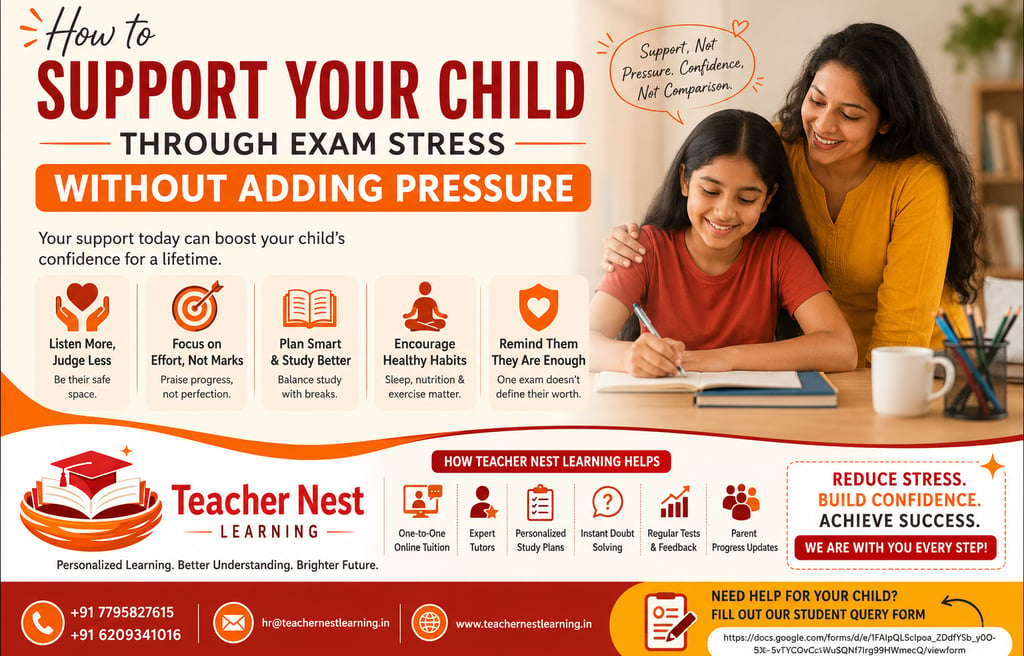

Exams are not stressful only for students. Parents also experience anxiety because they want their children to perform well. However, many parents unknowingly increase their child's stress by constantly talking about marks, comparing them with others, or expecting perfection.
The good news is that your support can make a huge difference. Children who feel emotionally safe often perform better than those who study under constant pressure.
This guide explains how parents can reduce exam stress while helping children stay motivated and confident.
Why Are Students So Stressed During Exams?
Exam stress is becoming increasingly common among school students.
According to the World Health Organization (WHO), mental health concerns among adolescents have increased significantly over the last decade, with academic pressure being one of the major contributing factors.
Some common reasons include:
Fear of disappointing parents
Heavy school syllabus
Social media distractions
Comparison with classmates
Competitive exams like JEE, NEET, CUET, SAT, and Olympiads
Fear of failure
Lack of confidence
Poor time management
Many students don't fear exams themselves. They fear the consequences of scoring less than expected.
Signs Your Child Is Experiencing Exam Stress
Every child reacts differently to stress.
Watch for these warning signs:
Emotional Signs
Irritability
Frequent crying
Mood swings
Anxiety
Low confidence
Feeling overwhelmed
Physical Signs
Headaches
Stomach aches
Difficulty sleeping
Fatigue
Loss of appetite
Study-Related Signs
Avoiding books
Procrastination
Difficulty concentrating
Forgetting learned concepts
Panic before tests
Early recognition helps prevent stress from becoming severe.
What Parents Should Avoid During Exams
Sometimes good intentions create unnecessary pressure.
Avoid saying things like:
❌ "You have to score above 95%."
❌ "Sharma Ji's son studies 10 hours daily."
❌ "If you don't get good marks, your future is finished."
❌ "You're wasting your time."
❌ "You always make careless mistakes."
Even casual comments can increase anxiety.
10 Ways to Support Your Child Without Adding Pressure
1. Focus on Effort Instead of Marks
Praise consistency, hard work, and improvement.
Instead of saying:
"You must get 95%."
Say:
"I'm proud that you're studying regularly."
Children become more confident when effort is appreciated.
2. Listen More Than You Speak
Sometimes children simply want someone to listen.
Ask questions like:
How are you feeling?
Which subject feels difficult?
Is there anything worrying you?
Avoid interrupting or immediately giving advice.
Listening creates emotional safety.
3. Help Them Make a Realistic Study Plan
Instead of asking them to study all day, help create a balanced schedule.
A good timetable includes:
Study sessions
Breaks
Sleep
Exercise
Meals
Revision
Short, focused sessions are more productive than long hours of forced studying.
4. Never Compare Them With Other Students
Every child learns differently.
Comparison can reduce motivation and self-esteem.
Focus on your child's personal progress rather than someone else's marks.
5. Encourage Regular Breaks
The brain cannot stay productive for hours without rest.
Encourage:
Walking
Stretching
Listening to music
Drawing
Deep breathing
Even a 10-minute break improves concentration.
6. Make Home a Calm Environment
Children perform better in peaceful surroundings.
Reduce unnecessary distractions such as:
Loud television
Frequent criticism
Family arguments
Constant questioning about studies
A calm home supports better learning.
7. Encourage Healthy Sleep
Sleep improves:
Memory
Concentration
Problem-solving
Emotional balance
Students should ideally sleep 8 to 10 hours, especially during exam preparation.
Late-night studying often reduces learning efficiency.
8. Provide Healthy Food
Nutrition directly affects brain performance.
Include:
Fruits
Nuts
Milk
Eggs
Green vegetables
Whole grains
Limit excessive junk food and sugary drinks.
9. Celebrate Small Wins
Completed one chapter?
Finished revision?
Improved in a mock test?
Celebrate these achievements.
Small victories build confidence.
10. Remind Them That Marks Do Not Define Their Worth
Children should know:
One exam cannot decide an entire life.
Success depends on many skills:
Discipline
Curiosity
Communication
Creativity
Consistency
Problem-solving
This mindset reduces unnecessary fear.
How Online Learning Can Reduce Exam Stress
Many students hesitate to ask doubts in crowded classrooms.
Personalized online learning offers:
One-to-one attention
Flexible schedules
Immediate doubt solving
Personalized study plans
Regular feedback
When students understand concepts clearly, their confidence naturally increases.
How Teacher Nest Learning Helps Students During Exams
Exam preparation becomes easier when students receive the right guidance instead of additional pressure.
Teacher Nest Learning focuses on helping students learn with confidence through personalized support rather than fear.
Students receive:
One-to-one online tuition
Expert tutors
Customized learning plans
Regular mock tests
Instant doubt solving
Progress tracking
Flexible scheduling
Individual attention in every class
Instead of simply completing the syllabus, Teacher Nest Learning helps students understand concepts deeply, making revision faster and reducing exam anxiety.
Parents also receive updates about their child's learning progress, creating a healthy partnership between teachers and families.
Daily Habits That Reduce Exam Stress
Simple habits can make a big difference.
Encourage your child to:
Wake up at a regular time
Drink enough water
Exercise for 20–30 minutes
Avoid excessive mobile usage
Revise daily instead of cramming
Practice previous years' question papers
Take short breaks
Sleep on time
Consistency is more powerful than studying all night before exams.
What to Say Before an Exam
Children remember supportive words.
Try saying:
"Do your best."
"We're proud of your effort."
"Stay calm."
"Believe in yourself."
"One exam doesn't define you."
"We'll support you no matter what."
These simple words reduce pressure and increase confidence.
Common Mistakes Parents Make During Exams
Avoid these common habits:
Constantly asking "How much have you studied?"
Checking on them every few minutes
Comparing marks with relatives
Punishing low scores
Increasing tuition hours without rest
Ignoring emotional well-being
Expecting perfection
Children need encouragement, not constant evaluation.
Frequently Asked Questions (FAQs)
How can parents reduce exam stress?
Parents can reduce exam stress by creating a supportive environment, avoiding comparisons, encouraging healthy routines, praising effort, and listening to their child's concerns.
Is exam stress normal?
Yes. Mild exam stress is common and can even improve focus. However, excessive stress that affects sleep, appetite, or emotional well-being should be addressed early.
Should parents force children to study longer?
No. Long study hours do not always improve performance. Quality study sessions with regular breaks are far more effective.
How many hours should a student sleep during exams?
School students generally need 8 to 10 hours of sleep to maintain concentration, memory, and emotional balance.
Can online tuition reduce exam stress?
Yes. Personalized online tuition helps students clear doubts quickly, learn at their own pace, and gain confidence before exams.
How does Teacher Nest Learning help students during exams?
Teacher Nest Learning provides one-to-one online classes, expert tutors, customized study plans, regular assessments, doubt-solving sessions, and personalized guidance. This helps students prepare confidently without unnecessary pressure while giving parents regular progress updates.
Final Thoughts
Every parent wants their child to succeed. But success grows best in an environment filled with encouragement, patience, and understanding rather than fear.
Remember that your child doesn't need a coach standing over every page. They need someone who believes in them even on difficult days.
Support their effort, celebrate their progress, and remind them that learning is a journey, not a race.
With the right emotional support and personalized academic guidance from Teacher Nest Learning, students can face exams with greater confidence, lower stress, and a healthier mindset toward success.
© 2026. All rights reserved Teacher Nest Learning™
Contact & Support


Teacher Nest Learning is a 1-to-1 online tuition platform offering personalized learning for CBSE, ICSE, IB, IGCSE, and State Boards. Our expert tutors focus on concept clarity, academic improvement, and preparation for competitive exams like JEE and NEET.
Email Us : hr@teachernestlearning.in
Class 9-10 (High)
Class 6-8 (Middle)
Class 11-12 (Higher)
Boards & Competitive
Student Resources
• Book a Free Demo
• Course Syllabus
• FAQ
• Study Materials
• Blog
Terms & Conditions
Refund & Cancellation Policy
Career
📍Registered Office: Dhanbad, Jharkhand, India.
+91 7795827615
+91 6209341016