
How to Score a 7 in IB Physics: Complete Study Plan for SL & HL Students
Many students believe that only naturally gifted learners can achieve a 7 in IB Physics. The reality is quite different. Most top-performing students succeed because they follow a structured study plan, practice consistently, and focus on understanding concepts rather than relying on rote learning.
TEACHER NEST LEARNING
6/20/20264 min read
Introduction
IB Physics is widely regarded as one of the most challenging subjects in the International Baccalaureate Diploma Programme. Whether you are studying Standard Level (SL) or Higher Level (HL), achieving a score of 7 requires much more than simply memorizing formulas and definitions. Students must develop a deep understanding of physical concepts, apply mathematical reasoning, analyze experimental data, and solve unfamiliar problems under exam conditions.
Many students believe that only naturally gifted learners can achieve a 7 in IB Physics. The reality is quite different. Most top-performing students succeed because they follow a structured study plan, practice consistently, and focus on understanding concepts rather than relying on rote learning.
The good news is that scoring a 7 is achievable for both SL and HL students when the right strategy is followed from the beginning of the course. This guide provides a complete study plan that can help students maximize their performance in IB Physics and approach exams with confidence.
Understanding What a 7 Requires
Before creating a study plan, students must understand what IB examiners expect. A score of 7 is awarded to students who demonstrate excellent conceptual understanding, strong problem-solving skills, accurate calculations, and the ability to apply knowledge in unfamiliar situations.
Unlike many school examinations, IB Physics rarely rewards memorization alone. Questions are often designed to test whether students can transfer their understanding to new scenarios. This means students must focus on learning the underlying principles behind every topic rather than simply remembering equations.
Students aiming for a 7 should develop mastery in three key areas: conceptual understanding, mathematical application, and examination technique. Weakness in any one of these areas can significantly impact final performance.
Build Strong Foundations First
One of the most common mistakes IB Physics students make is rushing through chapters without fully understanding the basics. Advanced topics often rely on concepts introduced earlier in the syllabus.
Topics such as mechanics, forces, energy, momentum, and waves form the foundation for many later chapters. If students struggle with these concepts, more advanced units become increasingly difficult.
The first phase of preparation should focus on mastering core concepts. Spend time understanding why formulas work, how variables relate to one another, and what physical principles govern different phenomena.
When learning a new topic, ask yourself:
• Why does this happen?
• What assumptions are being made?
• How does this concept connect with previous topics?
• Can I explain this concept without looking at my notes?
If the answer is yes, genuine understanding has likely been achieved.
Create a Weekly Study Schedule
Consistency is far more effective than occasional long study sessions. Students aiming for a 7 should dedicate regular time to Physics every week.
A practical study schedule may include:
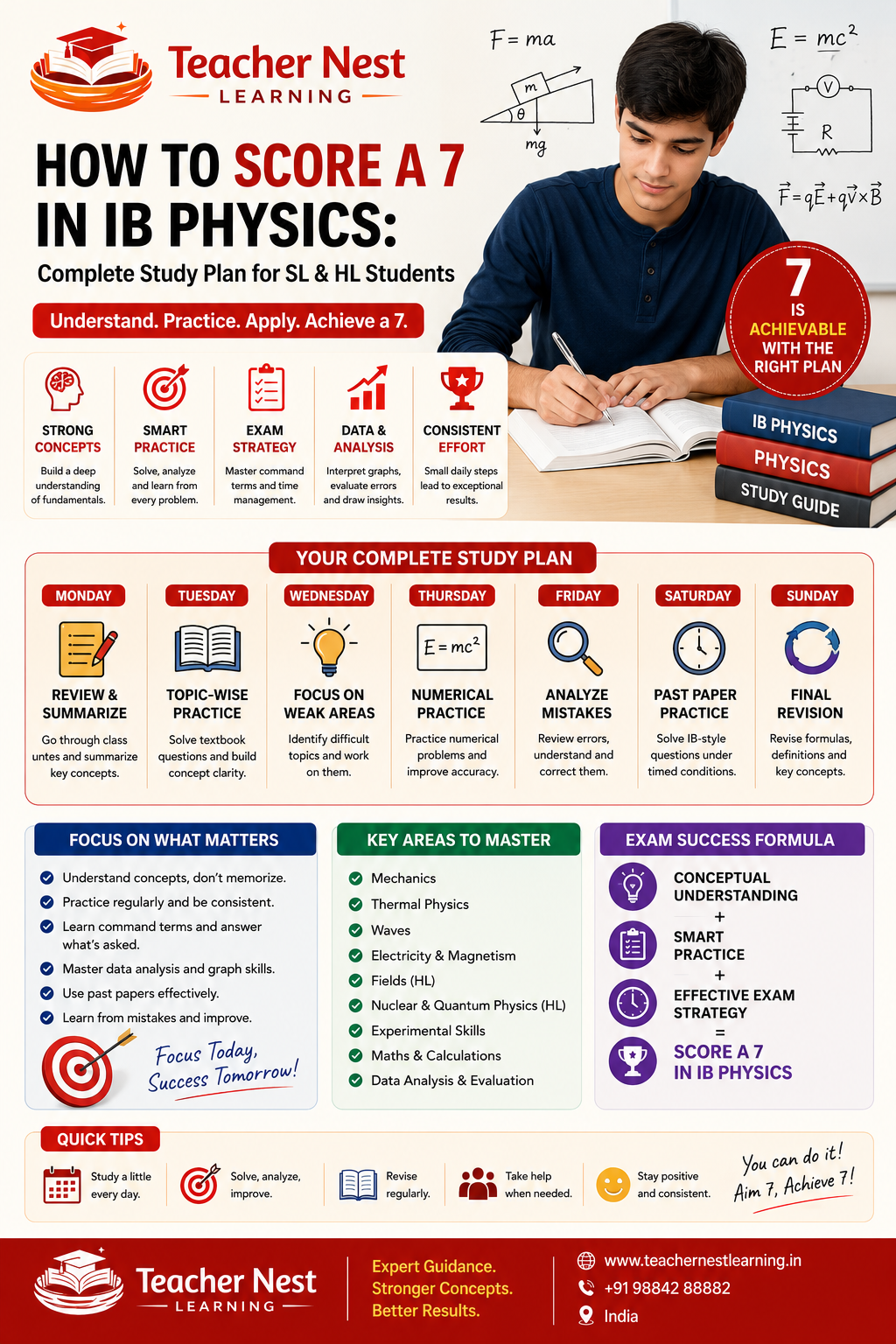
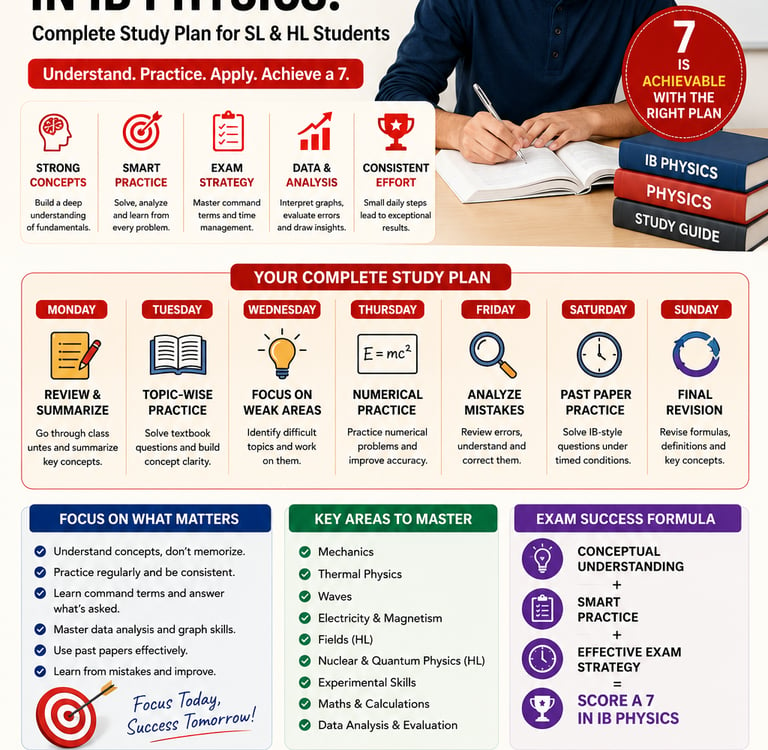
Monday: Review class notes and summarize concepts.
Tuesday: Solve topic-specific questions.
Wednesday: Focus on difficult concepts and weak areas.
Thursday: Practice numerical problems.
Friday: Review mistakes from previous work.
Saturday: Complete IB-style exam questions.
Sunday: Revise formulas, definitions, and experimental techniques.
Even 45 to 60 minutes of focused daily study can produce excellent results when maintained consistently over time.
Master Problem Solving Skills
Physics is ultimately a problem-solving subject. Understanding theory is important, but success in IB exams depends heavily on the ability to apply concepts accurately.
Whenever solving questions, avoid immediately looking at solutions. Instead, spend time identifying the relevant concepts, drawing diagrams, listing known variables, and selecting appropriate equations.
Students should develop the habit of solving questions from multiple sources. Different question styles expose students to various applications of the same concept and improve adaptability during examinations.
Keep a dedicated notebook for challenging problems. Reviewing difficult questions regularly helps reinforce learning and prevents repeated mistakes.
Use Past Papers Strategically
Past papers are one of the most powerful preparation tools available to IB students. However, many students use them incorrectly.
Instead of saving all past papers until the final months before exams, incorporate them throughout the learning process. After completing each topic, attempt relevant past paper questions to test understanding.
As examinations approach, begin solving complete papers under timed conditions. This helps students develop:
• Time management skills
• Exam stamina
• Familiarity with question patterns
• Confidence under pressure
Carefully review mark schemes after completing each paper. Understanding how marks are awarded is often just as important as understanding the content itself.
Focus on Command Terms
IB examinations use specific command terms that indicate the depth of response required.
For example:
Define requires a concise definition.
Explain requires reasoning and relationships.
Describe requires observations or characteristics.
Calculate requires numerical solutions.
Evaluate requires balanced judgment and analysis.
Many students lose marks because they answer a question differently from what the command term demands. Learning these command terms can significantly improve examination performance.
Develop Strong Data Analysis Skills
IB Physics places considerable emphasis on interpreting graphs, analyzing experimental results, and evaluating uncertainties.
Students should become comfortable with:
• Graph interpretation
• Error analysis
• Experimental design
• Data processing
• Practical investigations
These skills are particularly valuable because they appear across multiple examination papers and contribute to Internal Assessment success.
Prepare Differently for HL Physics
Higher Level students face additional challenges due to the increased depth and complexity of the syllabus.
HL students should allocate extra time for:
• Advanced Mechanics
• Fields
• Electromagnetic Induction
• Quantum and Nuclear Physics
• Additional HL Extensions
The best approach is to maintain pace with SL topics while gradually building confidence in HL-specific content. Leaving HL topics until the final months before exams often creates unnecessary stress.
Create a Formula and Concept Journal
Rather than maintaining a traditional formula sheet, create a journal that combines formulas with conceptual explanations.
For every formula, include:
• Meaning of variables
• Physical interpretation
• Units
• Common applications
• Limitations
This approach transforms formulas from isolated equations into meaningful problem-solving tools.
Track Mistakes and Learn from Them
Students who consistently score 7s often spend more time analyzing mistakes than celebrating correct answers.
Maintain an error log containing:
• Incorrect calculations
• Misinterpreted questions
• Forgotten concepts
• Weak topics
• Time management issues
Reviewing this log regularly helps eliminate recurring errors and ensures continuous improvement.
The Final Three-Month Revision Plan
Three months before examinations, preparation should become increasingly exam-focused.
Month 1 should focus on completing content revision and identifying weak topics.
Month 2 should emphasize topic-wise past paper practice and error correction.
Month 3 should involve full-length timed examinations, intensive revision, and final concept reinforcement.
During this period, students should prioritize quality over quantity. Deep understanding and focused practice produce far better results than simply completing large numbers of questions.
Conclusion
Scoring a 7 in IB Physics is not about studying endlessly or memorizing every detail in the textbook. It is about developing strong conceptual understanding, practicing consistently, mastering problem-solving techniques, and preparing strategically for examinations.
Both SL and HL students can achieve top scores by focusing on understanding rather than memorization, using past papers effectively, learning from mistakes, and maintaining a disciplined study routine throughout the course.
IB Physics rewards students who think critically, apply concepts confidently, and approach problems logically. With a structured study plan and consistent effort, achieving a 7 becomes a realistic and attainable goal rather than an intimidating challenge.
© 2026. All rights reserved Teacher Nest Learning™
Contact & Support


Teacher Nest Learning is a 1-to-1 online tuition platform offering personalized learning for CBSE, ICSE, IB, IGCSE, and State Boards. Our expert tutors focus on concept clarity, academic improvement, and preparation for competitive exams like JEE and NEET.
hr@teachernestlearning.in
+91 7795827615
+91 6209341016