
Comparing Your Child to Other Students: Why It Backfires
Blog post description.
TEACHER NEST LEARNING
6/27/20265 min read
Comparing Your Child to Other Students: Why It Backfire
"Look at Sharma Ji's son..."
"Your cousin studies much harder."
"Why can't you score like your classmate?"
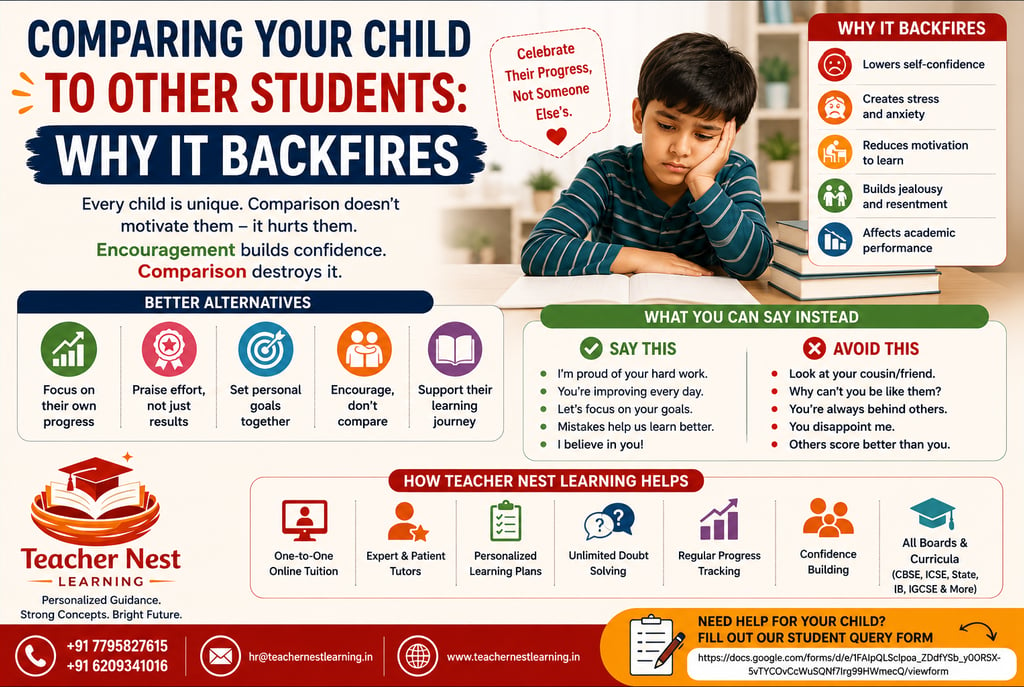
These are sentences that millions of children hear every year. Parents often compare their children with others hoping it will motivate them to perform better. However, educational psychology consistently shows that constant comparison usually creates pressure instead of progress.
Every child has a unique learning speed, personality, strengths, and interests. Comparing one child with another often damages confidence, increases anxiety, and weakens the parent-child relationship.
At Teacher Nest Learning, we believe every student deserves personalized guidance rather than unhealthy comparisons. Our one-to-one online tuition helps students improve based on their own potential instead of competing with someone else's journey.
Why Do Parents Compare Their Children?
Most parents compare their children because they genuinely want the best for them.
Common reasons include:
Concern about academic performance
Fear that their child is falling behind
Social pressure from relatives and friends
Competitive school environment
Desire to motivate improvement
While these intentions are understandable, the method often produces the opposite result.
What Happens When Children Are Constantly Compared?
1. Loss of Self-Confidence
When children repeatedly hear that someone else performs better, they begin believing they are "not good enough."
Instead of thinking:
"I can improve."
they start thinking:
"I will never be as good as them."
This damages self-esteem and reduces willingness to try.
2. Increased Stress and Anxiety
Comparison creates unnecessary pressure.
Children begin worrying about:
Test scores
Rankings
Pleasing parents
Fear of failure
Fear of disappointment
According to the World Health Organization (WHO), anxiety disorders are among the most common mental health challenges affecting young people worldwide, and excessive academic pressure can contribute significantly.
3. Fear of Making Mistakes
Students who are constantly compared often stop taking healthy academic risks.
Instead of asking questions, they think:
"What if I look foolish?"
Instead of attempting difficult problems:
"What if I fail?"
Learning becomes about avoiding mistakes instead of gaining knowledge.
4. Reduced Motivation
Many parents believe comparison motivates children.
Research suggests the opposite.
Children become motivated when they experience:
Small successes
Encouragement
Personal growth
Recognition of effort
Negative comparison often decreases intrinsic motivation.
5. Jealousy Towards Friends
Instead of celebrating classmates' achievements, children may begin seeing them as competitors.
This can affect:
Friendships
Teamwork
Classroom participation
Emotional well-being
Healthy competition inspires.
Constant comparison divides.
6. Lower Academic Performance
Ironically, comparison often reduces performance.
Children under excessive pressure:
Forget concepts during exams
Make careless mistakes
Lose concentration
Avoid challenging subjects
Confidence plays a major role in academic success.
Every Child Learns Differently
Modern education recognizes multiple learning styles.
Some children learn best through:
Visual explanations
Practical activities
Discussions
Reading
Problem solving
Repetition
Some understand Mathematics quickly but struggle with English.
Others excel in Science but need support in Social Science.
That doesn't make one child better than another.
It simply means they learn differently.
Real Success Comes from Personal Growth
Instead of asking:
"Why aren't you like your friend?"
Ask:
"Are you better than you were last month?"
This shift changes everything.
Children become excited about improvement rather than fearful of comparison.
The Hidden Damage of Constant Comparison
Long-term comparison may lead to:
Low self-esteem
Academic burnout
Depression
Social withdrawal
Fear of failure
Lack of confidence
Poor decision-making
Many adults who struggled with confidence report experiencing constant comparisons during childhood.
Better Alternatives to Comparison
Celebrate Small Improvements
Instead of focusing only on marks:
Celebrate:
Completing homework regularly
Asking doubts
Reading daily
Improved handwriting
Better concentration
Higher confidence
Progress deserves appreciation.
Compare Your Child with Their Own Past Performance
Instead of comparing with another student:
Ask:
Did they improve this month?
Are they more disciplined?
Are they making fewer mistakes?
Are they understanding concepts better?
Personal growth is the best benchmark.
Praise Effort, Not Just Results
Children should hear:
"I'm proud of your hard work."
"You improved a lot."
"Keep trying."
"You solved difficult questions today."
Effort builds resilience.
Help Them Set Personal Goals
Examples:
Improve Math score from 70% to 80%
Read one chapter daily
Solve 20 practice questions
Finish homework without reminders
Personal goals create long-term motivation.
Encourage Questions
Children should never fear asking doubts.
At Teacher Nest Learning, students are encouraged to ask unlimited questions without worrying about being judged.
Confidence grows when curiosity is appreciated.
What Research Says
Educational studies consistently show that students perform better when they experience:
Positive encouragement
Individual attention
Constructive feedback
Emotional support
Growth-oriented learning
Research by psychologist Carol Dweck on the Growth Mindset also highlights that praising effort and learning strategies encourages resilience and continuous improvement.
Signs Your Child May Be Feeling Compared
Watch for signs such as:
Avoiding studies
Frequent frustration
Crying after exams
Saying "I'm not smart."
Fear of report cards
Lack of confidence
Comparing themselves with friends
Avoiding difficult subjects
These are signals that your child may need encouragement rather than pressure.
How Teacher Nest Learning Helps Students Grow with Confidence
At Teacher Nest Learning, we focus on individual progress instead of unhealthy competition.
Our teaching approach includes:
One-to-one online tuition
Personalized learning plans
Patient and experienced tutors
Regular progress tracking
Unlimited doubt-solving support
Flexible class timings
Interactive learning methods
Confidence-building sessions
Parent progress updates
Exam-oriented preparation
Instead of asking students to compete with others, we help them compete with yesterday's version of themselves.
Tips for Parents
✔ Appreciate effort every day.
✔ Listen before giving advice.
✔ Celebrate improvement.
✔ Avoid comparing siblings.
✔ Encourage hobbies along with academics.
✔ Create a positive learning environment.
✔ Focus on learning instead of only marks.
✔ Let children progress at their own pace.
Final Thoughts
Every child has a different journey.
Some bloom early.
Some bloom later.
What matters is not who finishes first, but who continues learning with confidence and curiosity.
Comparison may create temporary pressure, but encouragement builds lifelong success.
Instead of asking your child to become someone else, help them become the best version of themselves.
With personalized guidance, patient mentoring, and consistent support from Teacher Nest Learning, every child can achieve meaningful academic growth while developing confidence that lasts beyond the classroom.
Frequently Asked Questions (FAQs)
Is comparing children good for motivation?
No. While it may create short-term pressure, research shows that constant comparison usually lowers confidence, increases stress, and reduces intrinsic motivation.
How can parents motivate children without comparing them?
Focus on personal improvement, celebrate effort, set achievable goals, praise consistency, and provide emotional support.
What should I do if my child feels discouraged after being compared?
Listen without judgment, reassure them that every learner is different, avoid further comparisons, and help them focus on their own progress rather than someone else's achievements.
How does Teacher Nest Learning help students build confidence?
Teacher Nest Learning provides one-to-one online tuition, personalized lesson plans, unlimited doubt-solving, regular progress tracking, and supportive teachers who encourage students to improve at their own pace instead of comparing them with others.
Why is personalized learning better than comparison?
Personalized learning identifies each student's strengths and areas for improvement. It helps children learn more effectively, reduces unnecessary pressure, and promotes steady academic growth with greater confidence.
Key Statistics
Anxiety disorders are among the most common mental health conditions affecting young people worldwide, with academic pressure being a contributing factor in many cases.
Research on growth mindset indicates that praising effort and effective learning strategies improves resilience and long-term academic outcomes.
Studies consistently show that students receiving individualized instruction often demonstrate stronger engagement and improved academic performance compared to those taught with a one-size-fits-all approach.
Keyword Focus: comparing children, academic pressure, parenting tips, student confidence, personalized learning, one-to-one tuition, online tuition, child motivation, academic growth, Teacher Nest Learning.
© 2026. All rights reserved Teacher Nest Learning™
Contact & Support


Teacher Nest Learning is a 1-to-1 online tuition platform offering personalized learning for CBSE, ICSE, IB, IGCSE, and State Boards. Our expert tutors focus on concept clarity, academic improvement, and preparation for competitive exams like JEE and NEET.
Email Us : hr@teachernestlearning.in
Class 9-10 (High)
Class 6-8 (Middle)
Class 11-12 (Higher)
Boards & Competitive
Student Resources
• Book a Free Demo
• Course Syllabus
• FAQ
• Study Materials
• Blog
Terms & Conditions
Refund & Cancellation Policy
Career
📍Registered Office: Dhanbad, Jharkhand, India.
+91 7795827615
+91 6209341016