CBSE Class 10 Board Exam 2027: Complete Preparation Roadmap
Blog post description.
TEACHER NEST LEARNING
6/25/20265 min read
The CBSE Class 10 Board Examination 2027 is one of the most important academic milestones in a student's educational journey. It serves as the foundation for future streams, career choices, and competitive exam preparation. While Class 10 board marks may not directly determine a student's future, they play a crucial role in building confidence, academic discipline, and subject mastery.
Every year, millions of students appear for the CBSE Class 10 Board Exams. According to CBSE statistics, pass percentages consistently remain above 90%, but students who score above 90% usually follow a structured preparation strategy rather than relying on last-minute studying.
If you're aiming for excellent results in the CBSE Class 10 Board Exam 2027, this complete roadmap will help you prepare effectively, avoid common mistakes, and maximize your score potential.
Understanding the CBSE Class 10 Board Exam Pattern
Before beginning preparation, students should understand what the exam demands.
The major subjects include:
Mathematics
Science
Social Science
English Language & Literature
Hindi or other second language
Assessment generally includes:
Theory examinations
Internal assessments
Practical activities
Project work
Periodic tests
CBSE increasingly focuses on:
Conceptual understanding
Competency-based questions
Case-study questions
Application of knowledge
Critical thinking skills
Simply memorizing answers is no longer enough.
Why Start Preparing Early?
Many students begin serious preparation only a few months before the exam. This often creates unnecessary pressure.
Students who start preparation from the beginning of Class 10 usually:
✅ Understand concepts better
✅ Experience less exam stress
✅ Perform better in school assessments
✅ Build stronger revision cycles
✅ Score higher in final exams
Research in educational psychology suggests that spaced learning and repeated revision improve long-term retention significantly compared to last-minute cramming.
The Ideal Preparation Timeline for CBSE Class 10 Board Exam 2027
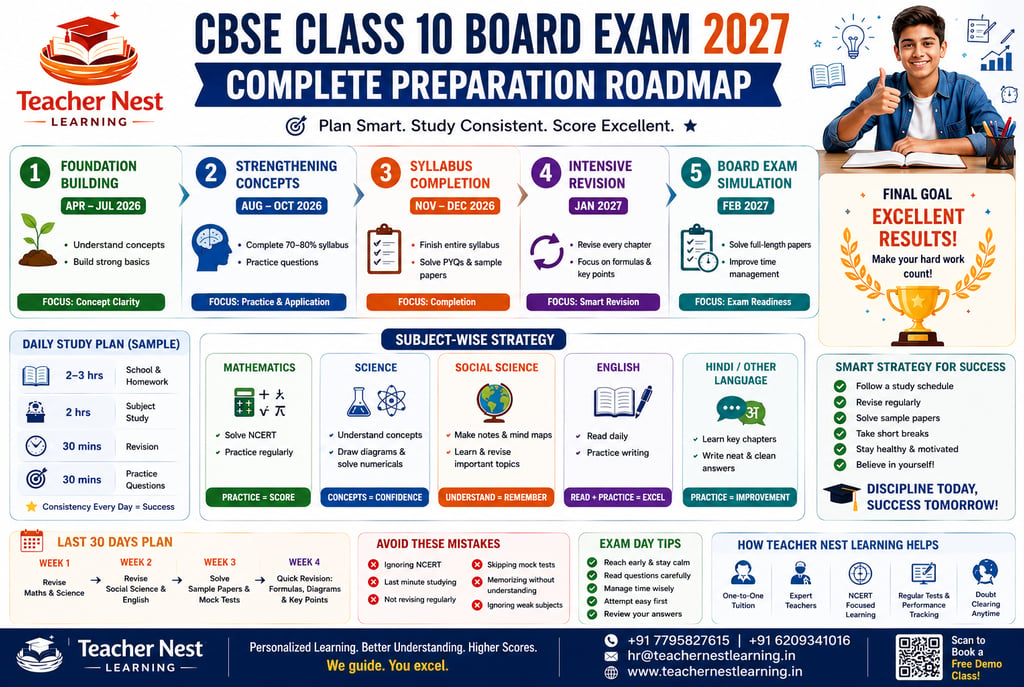
Phase 1: Foundation Building (April 2026 – July 2026)
The first four months should focus entirely on understanding concepts.
Goals
Complete classroom learning regularly
Read NCERT textbooks thoroughly
Maintain organized notes
Clear doubts immediately
Develop study discipline
Daily Study Plan
School homework: 1-2 hours
Self-study: 1-2 hours
Revision: 30 minutes
Focus Areas
Mathematics
Build strong understanding of:
Real Numbers
Polynomials
Linear Equations
Quadratic Equations
Coordinate Geometry
Science
Focus on concepts rather than definitions.
Subjects include:
Physics
Chemistry
Biology
Social Science
Understand timelines, maps, and concepts instead of rote memorization.
English
Improve:
Reading comprehension
Writing skills
Grammar
Literature analysis
Phase 2: Strengthening Concepts (August 2026 – October 2026)
This phase focuses on application and practice.
Goals
Finish 70-80% syllabus
Solve NCERT exercises
Begin competency-based questions
Strengthen weak chapters
Recommended Activities
Weekly chapter tests
Formula revision
Science diagrams practice
Map work practice
Writing practice for English
By October, students should have a clear understanding of every major chapter.
Phase 3: Syllabus Completion (November 2026 – December 2026)
By the end of December, the entire syllabus should ideally be completed.
Focus Areas
Mathematics
Practice:
Standard questions
HOTS questions
Competency-based questions
Sample papers
Science
Emphasize:
Numericals
Diagrams
Experiments
Application-based questions
Social Science
Focus on:
Important dates
Historical events
Geography maps
Political concepts
Phase 4: Intensive Revision (January 2027)
January is the most important month.
At this stage:
No new concepts should remain.
Revision becomes the top priority.
3-Revision Rule
Every chapter should be revised at least three times.
First Revision
Detailed revision of concepts.
Second Revision
Question solving and note review.
Third Revision
Exam-focused revision.
Students following this approach often retain information much more effectively.
Phase 5: Board Exam Simulation (February 2027)
This month should feel like the actual board examination.
Practice Full-Length Papers
Attempt:
Previous-year papers
CBSE sample papers
Mock examinations
Practice under timed conditions.
Benefits include:
Better time management
Improved accuracy
Reduced exam anxiety
Faster question-solving ability
Subject-Wise Preparation Strategy
Mathematics
Mathematics is one of the highest-scoring subjects.
Daily Practice
Spend at least 45-60 minutes daily.
Key Areas
Algebra
Geometry
Trigonometry
Statistics
Probability
Tips
Solve NCERT completely.
Maintain a formula notebook.
Practice previous-year questions.
Science Preparation Strategy
Science often determines overall board percentage.
Physics
Focus on:
Formula application
Numerical problems
Conceptual clarity
Chemistry
Master:
Chemical equations
Reactions
Carbon compounds
Biology
Practice:
Diagrams
Labeling
Definitions
Processes
NCERT remains the most important resource.
Social Science Preparation Strategy
Many students fear Social Science because of its vast syllabus.
Smart Strategy
Divide preparation into:
History
Geography
Political Science
Economics
Use:
Flowcharts
Mind maps
Timelines
These techniques improve memory retention significantly.
English Preparation Strategy
English can substantially improve overall percentages.
Reading Section
Practice comprehension passages regularly.
Writing Section
Prepare formats for:
Letters
Articles
Analytical paragraphs
Reports
Literature
Understand themes and character analysis rather than memorizing answers.
Common Mistakes Students Make
1. Ignoring NCERT
Most board questions originate directly or indirectly from NCERT.
Always prioritize NCERT.
2. Delaying Revision
Many students keep studying new chapters but neglect revision.
Without revision, retention drops rapidly.
3. Memorizing Without Understanding
CBSE increasingly asks competency-based questions.
Understanding concepts is more important than memorization.
4. Avoiding Weak Subjects
Students often spend time on favorite subjects and ignore difficult ones.
Balanced preparation is essential.
5. Lack of Mock Tests
Mock exams reveal:
Weak chapters
Time management issues
Common mistakes
Students who practice regularly usually perform better.
Importance of Time Management
A successful Class 10 student follows a realistic schedule.
Sample Weekday Plan
School: 7-8 hours
Homework: 1 hour
Subject Study: 2 hours
Revision: 30 minutes
Practice Questions: 30 minutes
Consistency matters more than studying for long hours occasionally.
Managing Board Exam Stress
Board exams can feel overwhelming.
Students should:
Sleep 7-8 hours daily
Take regular breaks
Exercise regularly
Limit social media distractions
Avoid comparing themselves with others
A healthy mind improves learning efficiency.
How Teacher Nest Learning Helps Students Score Higher in CBSE Class 10
Many students understand concepts better when they receive personalized guidance.
Teacher Nest Learning offers structured support designed specifically for CBSE students preparing for board examinations.
Personalized One-to-One Tuition
Every student receives individual attention tailored to their learning needs.
Experienced CBSE Teachers
Students learn from subject experts who understand CBSE examination patterns.
NCERT-Focused Learning
Teacher Nest Learning ensures complete mastery of NCERT concepts, which form the foundation of board exam success.
Regular Assessments
Frequent tests help students identify weak areas early.
Doubt-Clearing Sessions
Students can ask questions freely and build confidence.
Customized Study Plans
Each student receives a preparation roadmap based on their strengths and improvement areas.
Performance Tracking
Parents receive regular updates about academic progress and performance.
Last 30-Day Strategy Before the Board Exam
During the final month:
Week 1
Revise Mathematics and Science
Week 2
Revise Social Science and English
Week 3
Solve sample papers
Week 4
Focus on formulas, diagrams, and important concepts
Avoid learning completely new topics during the final days.
Final Thoughts
The CBSE Class 10 Board Exam 2027 is not about studying for endless hours. It is about studying smart, staying consistent, and building strong concepts throughout the year.
Students who begin preparation early, revise regularly, solve sample papers, and seek proper guidance often achieve excellent results with significantly less stress.
Success in Class 10 is not determined by intelligence alone. It is built through disciplined effort, effective planning, and continuous improvement.
With expert mentorship, personalized learning plans, regular assessments, and dedicated academic support, Teacher Nest Learning helps students prepare confidently and achieve their highest potential in the CBSE Class 10 Board Exam 2027.
Frequently Asked Questions (FAQs)
When should students start preparing for CBSE Class 10 Board Exam 2027?
Students should ideally begin structured preparation from the start of the academic session to build strong concepts and avoid last-minute stress.
Is NCERT enough for CBSE Class 10 Board Exams?
NCERT is the most important resource and should be thoroughly completed. Additional practice materials can be used after mastering NCERT.
How many hours should a Class 10 student study daily?
Most students can perform well with 2-4 hours of focused self-study daily, along with regular school attendance and revision.
How many times should the syllabus be revised?
Experts recommend revising every chapter at least three times before the board examination.
Are sample papers important for CBSE Class 10?
Yes. Sample papers help improve speed, accuracy, confidence, and familiarity with the exam pattern.
Can average students score above 90% in Class 10?
Absolutely. Consistent study, proper planning, regular revision, and expert guidance can help any dedicated student achieve excellent results.
How does Teacher Nest Learning help Class 10 students?
Teacher Nest Learning provides one-to-one tuition, experienced CBSE teachers, customized study plans, NCERT-focused learning, regular tests, and continuous academic support to help students excel in their board examinations.
© 2026. All rights reserved Teacher Nest Learning™
Contact & Support

Teacher Nest Learning is a 1-to-1 online tuition platform offering personalized learning for CBSE, ICSE, IB, IGCSE, and State Boards. Our expert tutors focus on concept clarity, academic improvement, and preparation for competitive exams like JEE and NEET.
Email Us : hr@teachernestlearning.in
Class 9-10 (High)
Class 6-8 (Middle)
Class 11-12 (Higher)
Boards & Competitive
Student Resources
• Book a Free Demo
• Course Syllabus
• FAQ
• Study Materials
• Blog
Terms & Conditions
Refund & Cancellation Policy
Career
📍Registered Office: Dhanbad, Jharkhand, India.
+91 7795827615
+91 6209341016